Tax
Get Paid by Big Clients: The eTIMS Invoice They Insist On
Why Kenyan buyers ask for an eTIMS invoice, what it must show, which free KRA option fits your business, and how to issue, check and correct one.
Biashara Pros editorial team 12 min read
Facts checked against official sources on 12 November 2026. How we check facts

An eTIMS invoice is a tax invoice issued through KRA’s electronic Tax Invoice Management System. Every business must issue one, VAT-registered or not. Business buyers ask for it because, without it, they can’t claim what they paid you as a business expense or, if they’re VAT registered, claim back the VAT. The KRA tools are free.
You quote a school, an office or a church for a December order. They like your price.
Then comes the question: “Can you give us an eTIMS invoice?”
If the answer is “No, but I can write you a receipt”, a buyer may thank you and pay someone else. Let’s make sure that never happens to you.
What is an eTIMS invoice, in plain words?
It’s an invoice you create inside a KRA system, so KRA gets a copy of the sale the moment you issue it.
eTIMS stands for electronic Tax Invoice Management System. KRA describes it as a software solution for tax invoicing that works on computers, laptops, tablets and smartphones[3].
The law behind it is section 23A of the Tax Procedures Act. It says a person who carries on business shall issue an electronic tax invoice through the KRA system and keep a record of stock in it[5].
A receipt book, a Word document or an invoice from a free online template is not an eTIMS invoice. Only invoices generated through the system count[5].
Why do buyers keep asking for an eTIMS invoice?
Because their own tax depends on it.
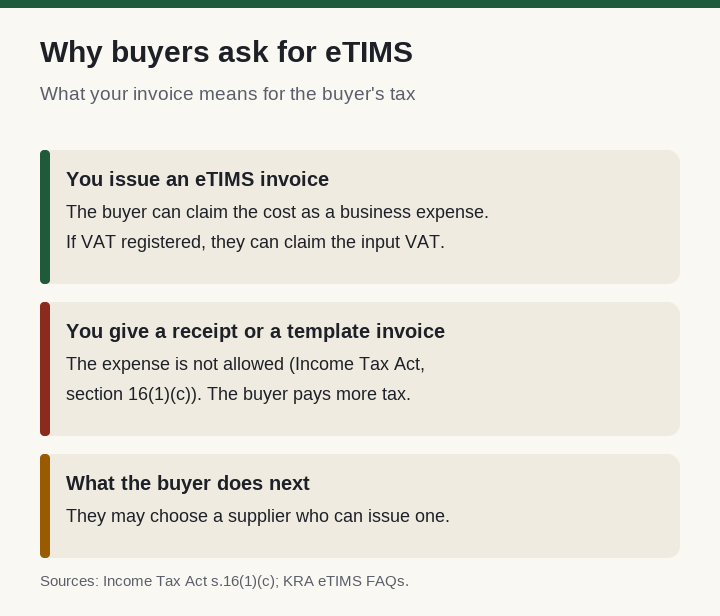
The Income Tax Act says no deduction is allowed for “any expenditure or loss where the invoices of the transactions are not generated from an electronic tax invoice management system”, except for exempted transactions[8].
KRA says this rule has applied to business expenses since 1 January 2024[1].
For example, when a company pays you KSh 80,000 for uniforms and you give no eTIMS invoice, it can’t count that KSh 80,000 as a cost. It pays more income tax because it bought from you.
KRA puts it plainly. Not issuing eTIMS-compliant invoices denies your customers the ability to claim their business expenses, and stops VAT-registered customers claiming the input VAT[3].
That’s why procurement officers, accountants and finance teams often ask about it early, before they settle on price.
Does my business need eTIMS if I’m not registered for VAT?
Yes. KRA says all persons engaged in business must on-board eTIMS and issue electronic tax invoices[1].
That includes companies, partnerships, sole proprietors, people paying Turnover Tax or Monthly Rental Income tax, and the informal sector[1].
It also includes businesses that don’t need VAT at all, like schools, hospitals and tour operators[1].
VAT is separate. You must register for VAT once your taxable sales reach KSh 5 million or more in a year[11]. eTIMS applies long before that.
What if my customer is a small seller who can’t issue one?
Then the law lets the buyer do it.
Where a supply comes from a small business or small-scale farmer with annual turnover of up to KSh 5 million, the purchaser shall issue the tax invoice[6].
KRA calls this Buyer Initiated Invoicing. The buyer logs in through eCitizen or *222#, enters your ID or PIN, the items, quantities and prices, and sends it to you[10].
You get an SMS, then approve or reject it through a USSD prompt on your phone. You have 30 days; after that, it’s rejected automatically[10].
It can’t be used for sellers who are VAT registered; the system blocks those[10].
This helps small suppliers. But a supplier who issues their own invoice on the spot saves the buyer that work, and looks ready for bigger orders.
What must an eTIMS invoice show?
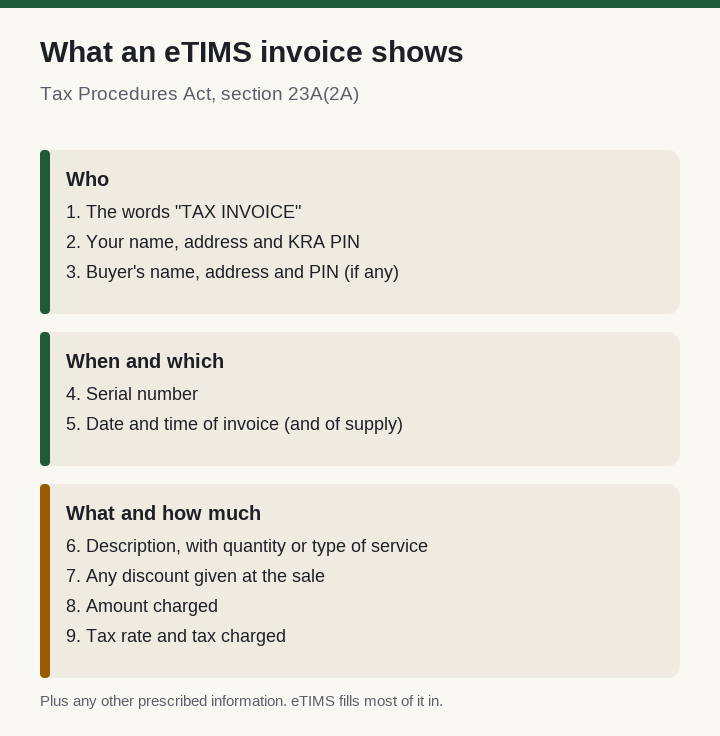
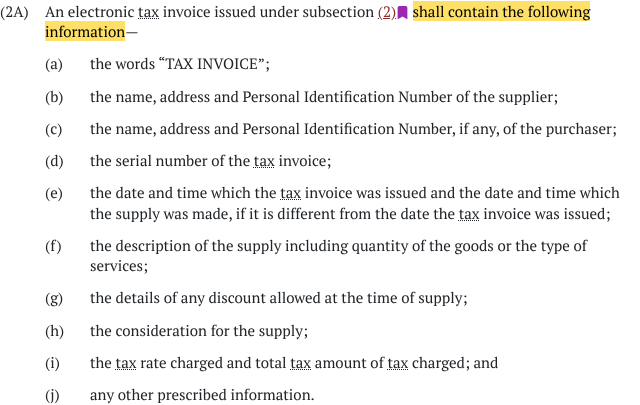
The Tax Procedures Act lists what every electronic tax invoice shall contain[5]:
- The words “TAX INVOICE”
- Your name, address and KRA PIN
- The buyer’s name, address and PIN, if they have one
- The invoice serial number
- The date and time of the invoice, and of the supply if different
- A description of the goods (with quantity) or the type of service
- Any discount given at the time of the sale
- The amount charged
- The tax rate and total tax charged
- Any other prescribed information
eTIMS fills most of this in for you. Your job is to get the buyer’s details and the item descriptions right.
Which eTIMS option fits my business?
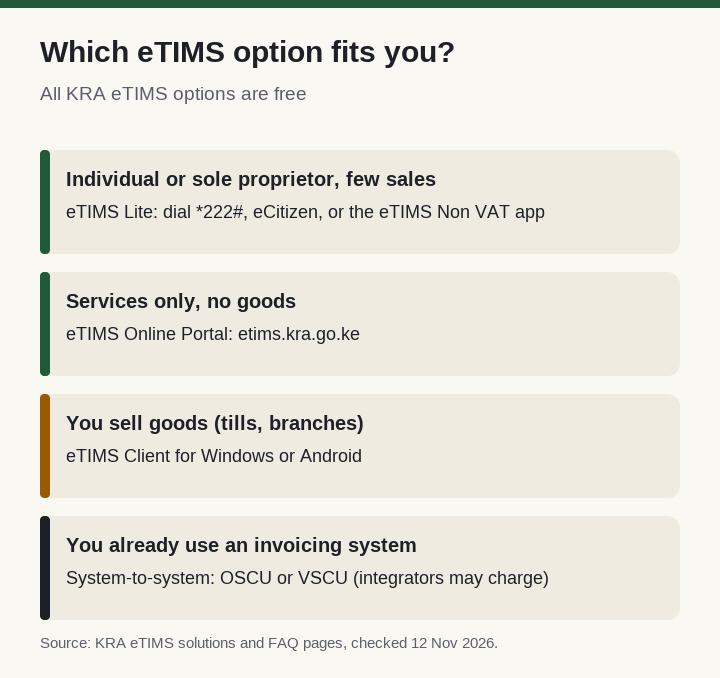
KRA offers several, all free[3]. Pick by what you sell and how many invoices you issue.
| Your business | KRA option | How you reach it |
|---|---|---|
| Individual or sole proprietor, few sales | eTIMS Lite (USSD or web) | Dial *222#, or eCitizen |
| Not VAT registered, prefers an app | eTIMS Lite mobile app | ”eTIMS Non VAT” on Play Store or Apple Store |
| Services only, no goods | eTIMS Online Portal | etims.kra.go.ke |
| Sells goods, or goods and services; shops with tills or branches | eTIMS Client | Download for Windows or Android |
| Already uses an invoicing or accounting system | System-to-system (OSCU or VSCU) | Through KRA integration or an approved integrator |
Sources: KRA eTIMS solutions and FAQ pages[3][4].
KRA says the USSD option is for individuals and sole proprietors[4]. The Online Portal is for businesses supplying services only[3].
You can register on more than one option. Each keeps its own invoice numbers[4].
How do you issue your first eTIMS invoice, step by step?
Set it up on a quiet day, not when a buyer is waiting at the counter.
- Check your iTax login and phone number. Sign-up sends an OTP to your iTax-registered mobile number[3].
- Register for eTIMS. KRA lets you self-on-board, with no wait for KRA approval[3].
- Pick your option from the table above and install or open it.
- Add your items or services with clear names and prices, so you don’t type them fresh each time.
- Ask the buyer for their details: business name, address and KRA PIN[5].
- Create the invoice, check quantities, any discount and the total, then issue it.
- Send the buyer a copy by email or WhatsApp, and keep yours.
- Ask them to confirm it’s valid. They can scan the QR code or use the invoice number checker on iTax[3].
Do a test run with a friend’s business or a small real sale before your big December order.
How do you correct a wrong eTIMS invoice?
You don’t delete it. You issue a credit note against it, then a fresh, correct invoice[10].
KRA says a credit note can only be raised from the same eTIMS option that issued the original invoice[4].
If you’re VAT registered, the VAT Act says a credit note may be issued only within six months of the original tax invoice, unless there’s a price dispute in court[9].
So fix mistakes quickly. A wrong PIN or amount that sits for months becomes a much bigger headache.
What does eTIMS cost, and how long does it take?
| Item | Cost or time |
|---|---|
| KRA eTIMS software (portal, client, Lite) | Free[3] |
| Linking your own system through an approved integrator | May cost you; agree the fee with the integrator[3] |
| Buyer Initiated Invoice approval window | 30 days, then auto-rejected[10] |
| VAT credit note window | Within 6 months of the invoice[9] |
| Keeping records | 5 years from the end of the reporting period[13] |
Sign-up time depends on your iTax details being current. If your phone number or email on iTax is old, update that first.
What happens if you don’t issue eTIMS invoices?
You lose buyers first. Then KRA may come knocking.
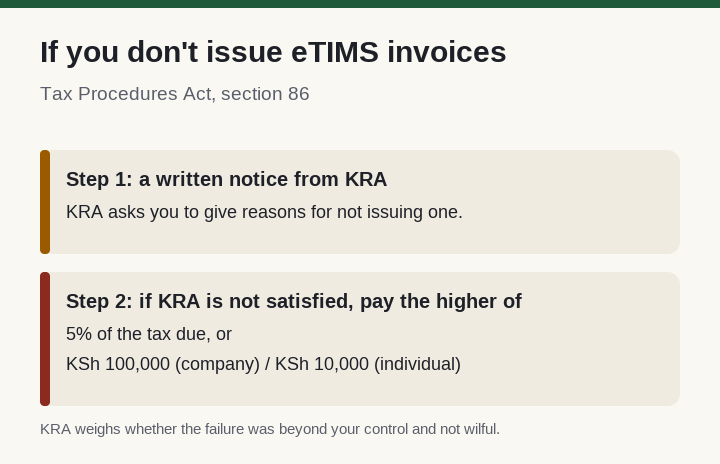
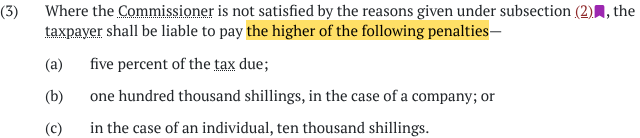
Under section 86 of the Tax Procedures Act, KRA first sends a written notice asking why you didn’t issue an electronic tax invoice[7].
If your reasons don’t satisfy KRA, you pay the higher of these[7]:
- 5% of the tax due, or
- KSh 100,000 for a company, or KSh 10,000 for an individual.
KRA weighs whether the failure was beyond your control, not wilful, and whether you fixed it as soon as you could[7].
Which costs don’t need an eTIMS invoice?
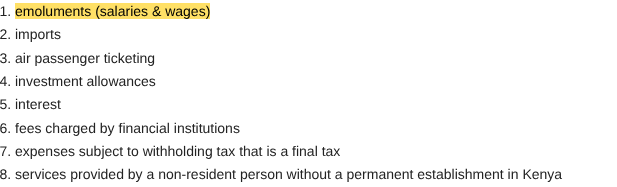
KRA lists business costs that are excluded from the eTIMS rule[2]:
- Salaries and wages
- Imports
- Air passenger tickets
- Investment allowances
- Interest
- Fees charged by banks and other financial institutions
- Expenses subject to withholding tax that is a final tax
- Services from a non-resident without a permanent establishment in Kenya
So you don’t chase your bank or your staff for eTIMS invoices. You do need them from the shops, transporters and service providers you buy from.
What do you need in hand before a buyer asks?
- Your KRA PIN and working iTax login
- Your iTax phone number up to date, for the OTP[3]
- Your eTIMS option set up and tested
- A price list loaded as items, with clear descriptions
- A simple way to collect each buyer’s name, address and PIN
- A folder (paper or cloud) for invoices and credit notes, kept 5 years[13]
- KRA’s eTIMS help line saved: 0711 099 999 or [email protected][12]
What tips make eTIMS easier for a small business?
- Invoice at the time of sale. It’s harder to remember quantities and prices a week later.
- Name items the way buyers order them. “Grey school sweater, size 30” beats “Item 14”.
- Get the PIN before you cook, sew or deliver. Ask for it with the LPO or deposit.
- Don’t share one device between businesses. KRA says the eTIMS Client can’t be installed on the same device for different companies[3]. One installation can serve several branches and tills[4].
- Using a TIMS ETR already? KRA says VAT-registered businesses may keep using it[3].
- Mention eTIMS in your quote. “eTIMS invoice provided” answers the question before it’s asked.
What should you never do with eTIMS invoices?
- Don’t issue an invoice for a sale that didn’t happen to help someone claim an expense. It’s false information on a tax record.
- Don’t let someone else invoice under your PIN. Every invoice is reported against you.
- Don’t show VAT on an invoice unless you’re VAT registered. The VAT Act gives the duty to issue tax invoices to registered persons, and says anyone who issues an invoice in breach of the rules commits an offence, with any tax shown becoming payable to KRA within seven days[14].
- Don’t ignore a Buyer Initiated Invoice SMS. Check it and approve or reject it within the 30 days[10].
- Don’t wait for a big order to set up. A buyer with a deadline won’t wait for your OTP problems.
Which eTIMS mistakes cost small businesses the most?
Thinking eTIMS is only for VAT businesses. KRA says every business must issue electronic tax invoices[1]. Set it up even if your turnover is small.
Wrong or missing buyer PIN. The buyer can’t match the invoice to their records. Ask for the PIN in writing, and read it back.
Cancelling by “starting afresh”. A new invoice without a credit note leaves both on record. Issue the credit note from the same option first[4].
Lumping items together. “Goods supplied: KSh 45,000” doesn’t describe the supply. The law asks for a description including quantity[5].
Forgetting the discount. If you gave money off at the sale, the invoice should show it[5].
What should be on your eTIMS checklist?
- KRA PIN and iTax login working.
- iTax phone number current.
- eTIMS option chosen and tested.
- Items and prices loaded.
- Buyer’s name, address and PIN collected before delivery.
- Invoice issued at the time of sale, with any discount shown.
- Copy sent to the buyer; QR code or invoice checker confirms it.
- Mistakes fixed with a credit note from the same option.
- Invoices kept for 5 years.
Want the bigger picture for December? Our guide to getting your business ready for December buyers covers stock, staff and cash. Our VAT calculator and Turnover Tax vs VAT tool help with the sums, and the compliance calendar keeps your KRA dates in view.
Still setting up your business? Start with how to register a business in Kenya.
If you have a Biashara Pros business page, add “eTIMS invoice provided” to it, so business buyers see it before they ask.
Common questions
Is an eTIMS invoice the same as an ETR receipt?
Not quite. Both send invoice details to KRA. KRA says VAT-registered businesses that already use a TIMS ETR device may keep using it, and those having technical problems with it are encouraged to move to eTIMS.
Can I issue an eTIMS invoice from my phone?
Yes. KRA offers eTIMS Lite on USSD by dialling *222#, for individuals and sole proprietors, and a mobile app listed on the Play Store and Apple Store as eTIMS Non VAT.
Do I need an eTIMS invoice for staff salaries or bank charges?
No. KRA lists emoluments (salaries and wages), imports, air passenger ticketing, interest and fees charged by financial institutions among the business costs excluded from the eTIMS requirement.
How long should I keep my invoices?
The Tax Procedures Act says records must be kept for five years from the end of the reporting period they relate to, unless a tax law sets a shorter period.
What happens if I do not receive the OTP when signing up for eTIMS?
KRA says to confirm you can reach your iTax-registered mobile number, update it in your iTax profile if not, and turn on promotional messages on your phone so the OTP can arrive.
Can my accountant set up eTIMS for me?
Sign-up is self-service. KRA says a representative can be appointed to handle a change of device for the eTIMS Client, with a signed introductory letter from a director, partner or the owner.
Can I use more than one eTIMS option at the same time?
Yes. KRA says taxpayers can register on more than one eTIMS solution. Each has its own invoice number sequence, and a credit note can only be raised from the solution where the original invoice was issued.
Sources
- KRA: What is eTIMS
"All persons engaged in business are required to on-board eTIMS and issue electronic tax invoices."

- KRA: What is eTIMS (business expenses excluded from eTIMS)
"The following valid business costs have been excluded from the requirement of being supported by an eTIMS invoice: emoluments (salaries & wages), imports, air passenger ticketing, investment allowances, interest, fees charged by financial institutions"
- KRA: Frequently asked questions on eTIMS
"Failure to issue eTIMS-compliant invoices for supplies denies your customers the ability to claim their business expenses when filing income tax returns. As well as claim the input VAT in their monthly VAT return"
- KRA: Types of eTIMS Solutions
"Each solution will have its own unique invoice number sequence. However, credit notes can only be generated from the solution where the original invoice was raised."
- Tax Procedures Act (Cap. 469B), section 23A (electronic tax invoices), Kenya Law
"An electronic tax invoice issued under subsection (2) shall contain the following information"
- Tax Procedures Act (Cap. 469B), section 23A(3A) (buyer issues the invoice), Kenya Law
"where a supply is received from a small business or a small-scale farmer, whose annual turnover does not exceed five million shillings, the purchaser shall issue a tax invoice"

- Tax Procedures Act (Cap. 469B), section 86 (failure to comply with electronic tax system), Kenya Law
"the taxpayer shall be liable to pay the higher of the following penalties— (a) five percent of the tax due; (b) one hundred thousand shillings, in the case of a company; or (c) in the case of an individual, ten thousand shillings."
- Income Tax Act (Cap. 470), section 16(1)(c), Kenya Law
"any expenditure or loss where the invoices of the transactions are not generated from an electronic tax invoice management system except where the transactions have been exempted"

- Value Added Tax Act, 2013, section 16 (credit notes), Kenya Law
"a credit note may be issued— (a) only within six months after the issue of the relevant tax invoice"

- KRA: Buyer Initiated Invoicing
"Sellers have thirty (30) days during which they may accept or reject the generated invoice after which the invoice is automatically rejected"
- KRA: Value Added Tax
"Any person supplying or who expects to supply taxable goods and taxable services with a value of Kshs 5 Million or more in a year is required to register for VAT."
- KRA: eTIMS Contact and Support Details
"+254 (0711) 099 999 ... [email protected]"
- Tax Procedures Act (Cap. 469B), section 23 (keeping documents), Kenya Law
"retain the document for a period of five years from the end of the reporting period to which it relates or such shorter period as may be specified in a tax law."
- Value Added Tax Act, 2013, section 42 (tax invoice), Kenya Law
"a registered person who makes a supply shall, at the time of the supply furnish the purchaser with the tax invoice ... Any person who issues an invoice in contravention of this subsection commits an offence and any tax shown thereon shall become due and payable to the Commissioner within seven days of the date of the invoice."
This is general information, not advice for your situation. Rules and rates change with each Finance Act. Before a decision with real money at stake, confirm with a licensed accountant or advocate. Spotted something out of date? Tell us at [email protected] and we will fix it.