Legal and compliance
Buy Land Without Losing Your Money to a Bad Title
Land search and title checks in Kenya: run an official search on Ardhisasa, read cautions and charges, farmland consent, stamp duty and a checklist.
Biashara Pros editorial team 14 min read
Facts checked against official sources on 24 November 2026. How we check facts

Before you pay for land in Kenya, get the title number and run an official search for KSh 1,000 on Ardhisasa or at the county land registry. The search shows who owns the land and any cautions, restrictions or bank charges on it. Then check the map on the ground, ask about family claims, get farmland consent where needed, and only then sign the transfer and pay stamp duty.
Maybe you want a plot for a warehouse in Ruiru. Or a quarter acre in Kitengela for a showroom.
Maybe you’re an agent, about to list a client’s land, and you don’t want your name on a bad deal.
Either way, the money is big and the mistakes are hard to undo.
This guide walks you through the checks the law gives you, in the order that protects your money.
Why does a land search matter so much in Kenya?
Because the register, not the paper in the seller’s hand, decides who owns registered land.[1] A search shows you what the register says today.
The Land Registration Act says courts take a certificate of title as prima facie evidence that the person named is the absolute owner[1].
But that title can be challenged on the ground of fraud or misrepresentation the owner was party to, or where it was acquired illegally, unprocedurally or through a corrupt scheme[1].
So a title can look perfect and still be fought over in court for years. Your job is to find the problems before you pay, not after.
What is an official search?
An official search is a certificate from the land registry showing the current entries on a parcel’s register.
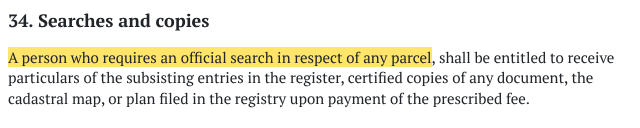
The Act says anyone who applies and pays the fee gets the subsisting entries in the register, certified copies of documents, and the cadastral map or plan filed in the registry[3].
A cadastral map is the official survey map showing the parcel’s boundaries.
How do you run a land search, step by step?
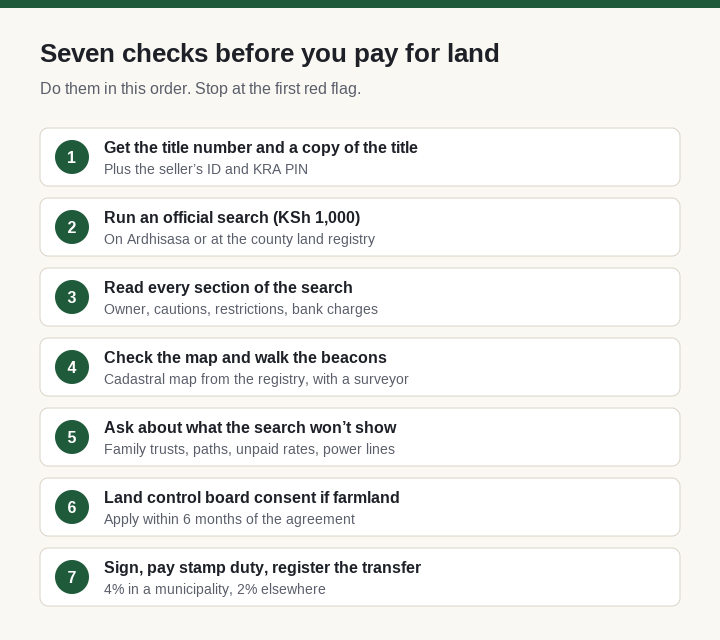
Apply with the title number, pay KSh 1,000, and collect the certificate. Here is the full order.
- Get the title number and a copy of the title from the seller. The search form starts with the title number[5].
- Get the seller’s ID and KRA PIN copies. You will check them against the name on the register.
- Apply for the official search. The Regulations say you apply in Form LRA 84, and the registry issues a certificate in Form LRA 85[5].
- Use Ardhisasa where your registry is on it. Ardhisasa is the national land information system built by the Ministry of Lands and Physical Planning with the National Land Commission[11]. Its home page offers “Search Property”, “Transfer Property” and “Order A Plan”[11].
- Otherwise go to the county land registry. The State Department for Lands lists registries county by county, with their offices and departments[12].
- Pay the fee. It is KSh 1,000 for an official search, online or manual[6].
- Collect the certificate. The registry’s service timeline is within 5 days for a search certificate[5].
An online certificate counts. The Regulations say an electronic search may be relied on the same way as a manual one, to the extent of what it shows[5].
The form asks for your name, ID or passport number, KRA PIN, phone and the purpose of the search[5]. It also says searches can be made by interested parties or their agents[5].
What should you look for on the search certificate?
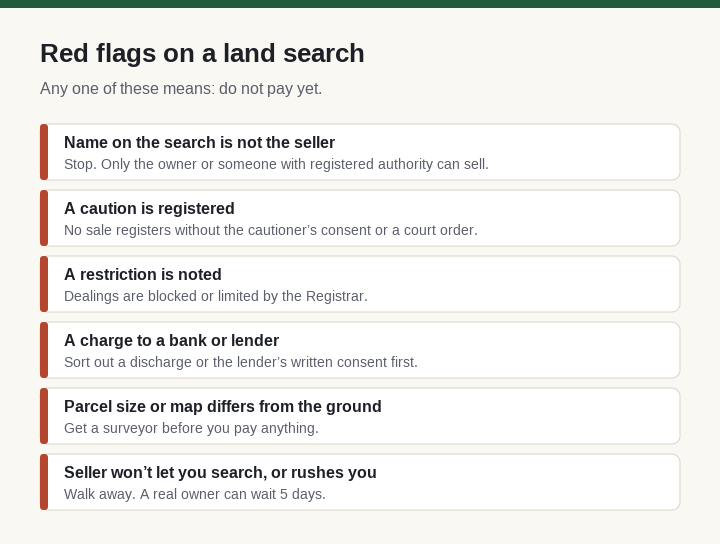
Check the owner’s name, then every entry that could block or burden the sale. The search form lets you ask for the property, proprietorship and encumbrances sections of the register[5].
Read it slowly. Here is what each entry means for you.
- Proprietor. The name must match the seller’s ID exactly. If it is a company, ask for the company’s details too, and see our guide on checking a company’s registration.
- Caution. A caution warns that someone has a claim. While it is registered, a sale inconsistent with it will not register unless the cautioner consents or a court orders it[4].
- Restriction. The Registrar can order a restriction prohibiting or restricting dealings, for example to prevent fraud[4].
- Charge. This is a loan secured on the land. If the charge says the owner can’t transfer without the lender’s consent, no transfer registers until that written consent reaches the Registrar[4].
- Parcel size. Note it down. You will compare it with the map and the ground.
Can you hold the land while you finish the deal?
Yes, for 14 days, if the owner consents in writing. The Act says where you apply for an official search with the owner’s written consent and state the proposed deal, registration of other dealings is stayed for 14 days[3].
If your properly signed transfer is presented within that period, it gets priority over other entries lodged during it[3].
That 14-day window is useful. Line up your payment and your documents so you can lodge inside it.
What won’t the search show you?
Some rights bind the land without appearing on the register at all. The Act calls them overriding interests[2].
They include, unless the register says otherwise[2]:
- trusts, including customary trusts (family members with a claim through custom)
- rights of way, rights of water and profits that already existed at the time of first registration
- charges for unpaid rates that another law makes a charge on land
- rights gained, or being gained, by long occupation under the law on limitation of actions or by prescription
- power lines, telephone lines, pipelines and similar works laid under a law
So the search is the start, not the end. You still visit, ask and look.
Family matters too. The Act says land a spouse gets during a marriage for the co-ownership and use of both spouses is treated as matrimonial property under the Matrimonial Property Act[2]. Ask who lives on the land and whether the seller is married.
How do you check the land on the ground matches the title?
Get the map, then walk the beacons with a licensed surveyor. The official search entitles you to the cadastral map or plan filed in the registry[3].
On site, look for:
- Beacons at each corner, matching the map.
- People living or farming on the land, and on what terms.
- Paths, water points and power lines crossing it.
- The access road, and whether it is a public road or a neighbour’s goodwill.
A surveyor can tell you if the beacons sit where the map says. That one visit can save you from buying a plot that is really half your neighbour’s.
Do you need land control board consent?
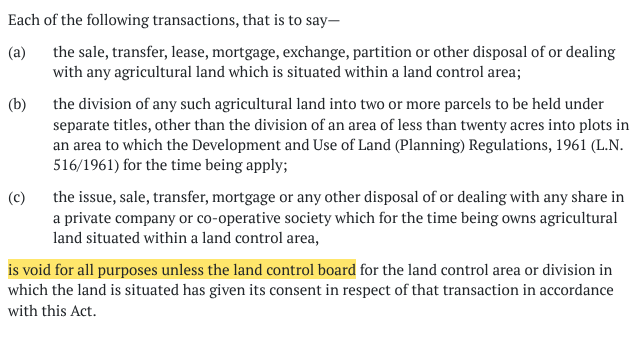
Yes, if it is agricultural land inside a land control area. The Land Control Act says a sale, transfer, lease, charge or subdivision of such land is void for all purposes without the board’s consent[7].
The same applies to buying shares in a private company or co-operative that owns such land[7].
You must apply within six months of making the agreement[7]. The High Court can extend that, but don’t count on it[7].
If the deal becomes void, money paid can be recovered as a debt from whoever received it[7]. Recovering it can still mean a court case. So pay a small deposit, get consent, then release the balance.
For how to split payments safely, see our deposit and milestone payment guide.
How much does buying land cost in fees and duty?
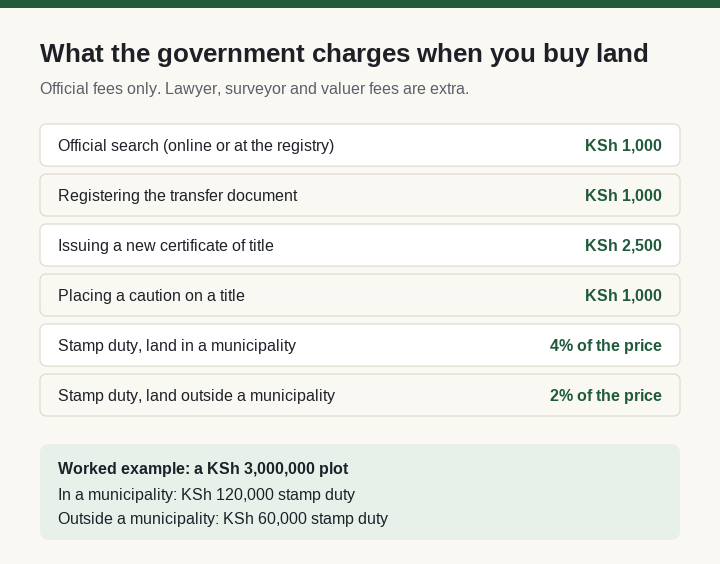
Plan for KSh 1,000 for the search, KSh 1,000 to register the transfer, and stamp duty of 4% or 2% of the price. These are the official charges; professional fees come on top.
The Land Registration (General) Regulations set these fees[6]:
| Service | Official fee |
|---|---|
| Official search, online or manual | KSh 1,000 |
| Registering a document or instrument | KSh 1,000 |
| Issuing a certificate of title or lease | KSh 2,500 |
| Placing a caution or restriction | KSh 1,000 |
Stamp duty is paid by the buyer[8]. The Stamp Duty Act Schedule charges KSh 40 for every KSh 1,000 above the first KSh 2,000 on land in a municipality, which works out to 4%[8].
Outside a municipality, it is KSh 20 for every KSh 1,000, which is 2%[8]. A transfer between husband and wife is charged nil[8].
Worked example. On a KSh 3,000,000 plot, stamp duty is KSh 120,000 in a municipality and KSh 60,000 outside one[8].
Don’t under-declare the price. The Collector of Stamp Duties refers land transfers to the Chief Government Valuer for their open market value, and if more duty is due, you must pay it within 21 days of the notice[8].
Lawyer, surveyor and valuer fees vary by the size of the deal and the work involved. Ask each for a written quote before they start.
How long does a land deal take?
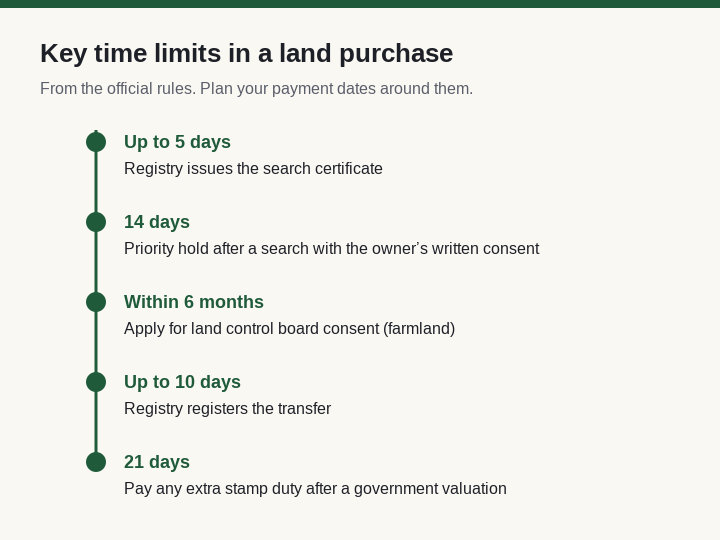
Weeks, not days, once you add the checks. The official service timelines are a good base[5]:
- Search certificate: within 5 days.
- Transfer registration: within 10 days.
- Cautions and their withdrawal: within 10 days.
Add the 14-day priority window[3], the board consent for farmland[7], and any valuation for stamp duty[8].
What should you check before you build or list?
Before you build, get county development permission. Before you list, make sure you, and the seller, are on solid ground.
The Physical and Land Use Planning Act says no one shall carry out development in a county without development permission[9].
Starting without it can mean a fine of up to KSh 500,000, up to two months in jail, or both[9]. The county can also order you to restore the land within 90 days[9].
If you build for clients, our guide on NCA registration and getting paid covers the contractor side.
If you sell land for others, the Estate Agents Act says no individual shall practise as an estate agent unless registered[10]. For a company, every director doing that work must be registered[10].
Fines reach KSh 1 million for an individual and KSh 5 million for a company[10]. Run a search before you advertise any plot, so you never sell a client’s buyer a problem.
Must-haves before you pay a shilling
- The title number and a copy of the title.
- A current official search in your hands, read line by line.
- The seller’s ID and KRA PIN, matching the register.
- The cadastral map and a surveyor’s site visit.
- Board consent for farmland in a land control area.
- A written sale agreement, reviewed by an advocate.
- Money set aside for stamp duty and fees, on top of the price.
Many buyers use an advocate to run the conveyancing, which is the legal work of transferring ownership. Ask for their practising status and a written fee quote first.
Tips from how it works in Kenya
- Search twice. Once before you agree a price, and again just before you pay. New cautions can appear in between.
- Visit on a weekday and a weekend. You meet different neighbours, and neighbours know who really owns what.
- Pay to accounts, never cash. Bank transfer or M-Pesa to the registered owner or the advocate’s client account leaves a record.
- Ask the chief or village elder. For rural land, local leaders often know about family disputes long before the registry does.
- Keep a deal folder. Search, map, IDs, agreement, receipts and stamp duty slips, scanned to your email.
- Use the right Ardhisasa line. Ardhisasa lists customer care contacts for Nairobi, Murang’a, Mombasa and Isiolo[11].
What should you never do?
- Never pay a deposit before the search. If the land turns out to be charged or cautioned, getting it back is hard.
- Never rely on a photo of a title on WhatsApp. Check the register itself with an official search[3].
- Never buy from someone “selling for the owner” without a registered power of attorney and a search in the owner’s name.
- Never skip the site visit because the price is good. Low prices often hide a dispute.
- Never start building before county approval[9].
Common mistakes that cost buyers
Treating the title deed as proof. A title can be challenged for fraud or an illegal process[1]. Instead, run a fresh official search.
Ignoring unregistered rights. Customary trusts and rights of way bind the land without being on the register[2]. Instead, ask, visit and look.
Missing the six-month consent window on farmland. The deal can become void[7]. Instead, apply to the board straight after signing.
Forgetting stamp duty in the budget. On a KSh 3,000,000 plot in a municipality that’s KSh 120,000[8]. Instead, budget for it from day one.
Letting an unregistered agent run the sale. They are breaking the law[10], and you may have little comeback. Instead, deal with registered agents or directly with the owner.
Your land purchase checklist
- Title number and title copy in hand.
- Official search done (KSh 1,000), read line by line.
- Seller’s ID and PIN match the register.
- No caution, restriction or unexplained charge.
- Map checked and beacons walked with a surveyor.
- Questions asked about family, paths and occupants.
- Board consent for farmland, within 6 months.
- Agreement reviewed by an advocate.
- Stamp duty and fees budgeted.
- Second search just before you pay.
This guide is general information, not legal advice. Land deals vary, so speak to an advocate before you sign. More for property businesses on our real estate industry page.
Buyers looking for surveyors, valuers and property advocates find checked businesses on Biashara Pros.
Common questions
Can I do a land search without the title number?
Not reliably. The official search application, Form LRA 84, starts with the title number of the parcel. Ask the seller for it, together with a copy of the title, before you pay anything. A seller who will not share the title number is a red flag.
Who is allowed to apply for an official land search?
The search form says applications can be made by interested parties or their agents, and defines an agent as a person or firm registered by a professional body. The form asks for your name, ID or passport number, KRA PIN and contacts, plus the purpose of the search.
Is an online search on Ardhisasa as good as one from the registry?
Yes, for the information it shows. The Land Registration (General) Regulations say a certificate of official search obtained electronically may be relied on in the same manner as one obtained manually, to the extent of the information it contains.
Do I pay stamp duty when I transfer land to my spouse?
No. The Stamp Duty Act Schedule sets the duty on a conveyance or transfer of real property between husband and wife at nil. Registration fees at the land registry still apply.
What happens if the land control board refuses consent after I have paid?
The Land Control Act makes a controlled transaction void without consent, and says money paid in the course of a void transaction can be recovered as a debt from the person it was paid to. Recovering it can still mean going to court, so get consent before you release the full price.
Can I put a caution on land I am buying?
A person who claims a right to an interest in the land, such as a buyer under a sale agreement, can apply to lodge a caution under the Land Registration Act, in the prescribed form, and the Registrar may ask for a statutory declaration to support it. The fee is KSh 1,000. The Registrar can reject a caution that is unnecessary, so take advice on whether it fits your deal.
Do I need county approval to build on land I already own?
Yes. The Physical and Land Use Planning Act says no one shall carry out development within a county without development permission from the county. Building without it can lead to a fine of up to KSh 500,000, up to two months in jail, or both, and an order to restore the land.
Sources
- Land Registration Act (Cap. 300), sections 24 and 26 (registration vests ownership; certificate of title as evidence), Kenya Law
"the title of that proprietor shall not be subject to challenge, except ... on the ground of fraud or misrepresentation to which the person is proved to be a party; or ... where the certificate of title has been acquired illegally, unprocedurally or through a corrupt scheme."
- Land Registration Act (Cap. 300), sections 28 and 93 (overriding interests, matrimonial property), Kenya Law
"all registered land shall be subject to the following overriding interests as may for the time being subsist and affect the same, without their being noted on the register ... trusts including customary trusts; rights of way ... charges for unpaid rates"
- Land Registration Act (Cap. 300), sections 34 and 36 (official searches, 14-day priority), Kenya Law
"A person who requires an official search in respect of any parcel, shall be entitled to receive particulars of the subsisting entries in the register, certified copies of any document, the cadastral map, or plan filed in the registry upon payment of the prescribed fee."
- Land Registration Act (Cap. 300), sections 59, 71 to 73 and 76 (lender consent, cautions, restrictions), Kenya Law
"A disposition that is inconsistent with the caution shall not be registered while the caution is still registered except with the consent of the cautioner or by the order of the court."
- Land Registration (General) Regulations, regulation 86, Third Schedule and Form LRA 84 (official search, service times), Kenya Law
"A certificate of official search obtained electronically may be relied on in the same manner as a certificate of official search that was obtained manually to the extent of the information it contains."
- Land Registration (General) Regulations, Seventh Schedule (fees), Kenya Law
"Application for official search under section 34 of the Act (online and manual). 1,000"

- Land Control Act (Cap. 302), sections 6, 7 and 8 (land control board consent), Kenya Law
"is void for all purposes unless the land control board for the land control area or division in which the land is situated has given its consent in respect of that transaction in accordance with this Act."
- Stamp Duty Act (Cap. 480), section 10A and Schedule items 11, 12A and 12B (duty on land transfers), Kenya Law
"12A. Conveyance or Transfer on sale of any immovable property ... situated in any municipality ... And for every Sh. 1,000, and also for any fractional part of Sh. 1,000, in excess of Sh. 2.000 ... Sh. 40"
- Physical and Land Use Planning Act (Cap. 303), section 57 (development permission), Kenya Law
"A person shall not carry out development within a county without a development permission granted by the respective county executive committee member."
- Estate Agents Act (Cap. 533), section 18 (unregistered persons not to practise), Kenya Law
"no individual shall practise as an estate agent unless he is a registered estate agent"
- Ardhisasa: national land information system (services and customer care), Ministry of Lands and Physical Planning
"It has been developed jointly by the Ministry of Land and Physical Planning (MoLPP) and the National Land Commission (NLC) and key partners in Government. It allows the lodgment of applications for various services offered by the Ministry and the Commission."
- State Department for Lands and Physical Planning: land registries by county
"Land Registries ... County ... Station ... Location ... Name of Department(s) ... Land Registration, Land Administration, Land Valuation"
This is general information, not advice for your situation. Rules and rates change with each Finance Act. Before a decision with real money at stake, confirm with a licensed accountant or advocate. Spotted something out of date? Tell us at [email protected] and we will fix it.