Legal and compliance
Stop Chasing Payment on Building Jobs: NCA and Contract Steps
Who must register with the National Construction Authority, what NCA 1 to NCA 8 mean, renewals, the levy, and how Kenyan contractors get paid on time.
Biashara Pros editorial team 14 min read
Facts checked against official sources on 17 November 2026. How we check facts

Anyone in Kenya who, for pay, builds, installs or alters structures for other people and supplies the materials or labour must be registered with the National Construction Authority (NCA), unless a narrow exemption applies. You apply to NCA with your documents and fee, NCA scores you into a category (NCA 1 to NCA 8 for building works) that caps the job size you can take, and you renew every year. Getting paid on time comes down to the contract: stages, deadlines, retention and tax deductions agreed in writing.
You’ve done the work. The slab is cast, the photos are on WhatsApp, and the client says, “Next week.”
Next week becomes next month.
If that sounds familiar, you’re not alone.
This guide covers both halves of the problem: getting registered properly, and getting your money in full.
Who has to register with the National Construction Authority?
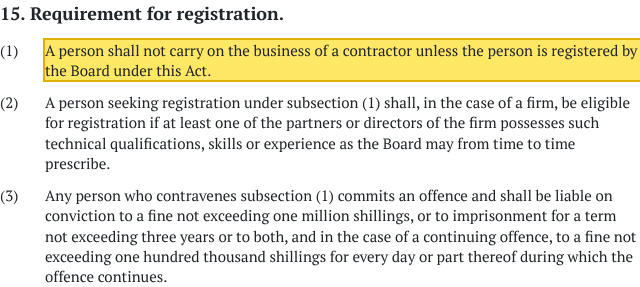
Anyone who carries on the business of a contractor. The NCA Act says a person shall not carry on the business of a contractor unless registered by the NCA Board[1].
The Act defines a contractor as someone who, for reward, builds, installs, erects or alters any structure for another person, and supplies the materials or the labour, or controls them[2].
That covers far more than big building firms.
Roadworks, boreholes, sewers, electrical installation, painting, carpentry and masonry all appear in the Act’s list of classes of works[2].
Who doesn’t have to register?
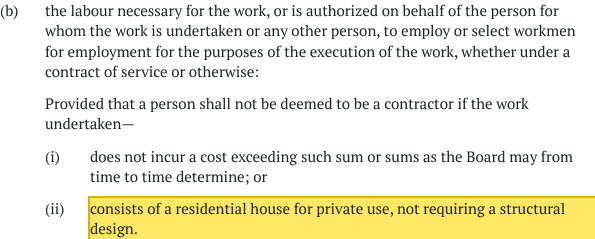
The Act gives two exceptions[2]:
- Small jobs below a cost the NCA Board sets from time to time.
- A residential house for private use that does not need a structural design.
The NCA Regulations add that skilled construction workers and site supervisors doing those exempt works do not need contractor registration[5].
What if you work without registering?
It’s a criminal offence.
On conviction, the fine can reach KSh 1 million, or up to three years in prison, or both. A continuing offence can add up to KSh 100,000 for every day it goes on[1].
There’s a quieter cost too. An owner must award construction work only to a contractor registered under the Act[8]. Unregistered, you can’t lawfully be awarded construction work that needs a registered contractor.
What do NCA 1 to NCA 8 mean?
They are categories that cap the value of a single job you can take. NCA 1 is the highest, with no limit. For building, road and water works, NCA 8 is the entry level. Electrical and mechanical contractors are graded NCA 1 to NCA 6, or NCA 1 to NCA 4 for some specialist sub-classes[7].
NCA evaluates each application in three stages: mandatory documents, a technical score out of 70 and a financial score out of 30[7]. Your total score places you in a category.
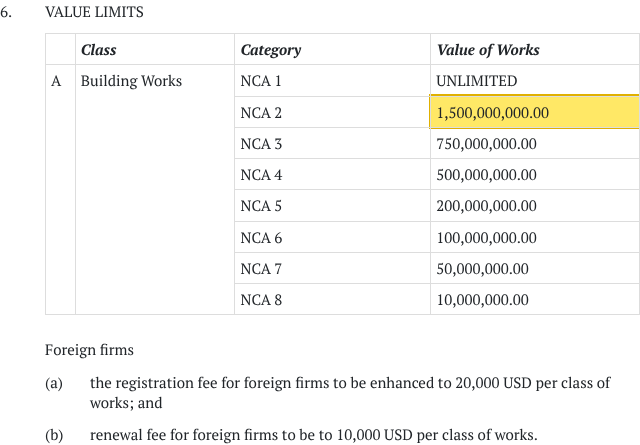
For building works, the Schedule to the NCA Regulations sets these value limits[7]:
| Category | Highest value of a single building job |
|---|---|
| NCA 1 | No limit |
| NCA 2 | KSh 1.5 billion |
| NCA 3 | KSh 750 million |
| NCA 4 | KSh 500 million |
| NCA 5 | KSh 200 million |
| NCA 6 | KSh 100 million |
| NCA 7 | KSh 50 million |
| NCA 8 | KSh 10 million |
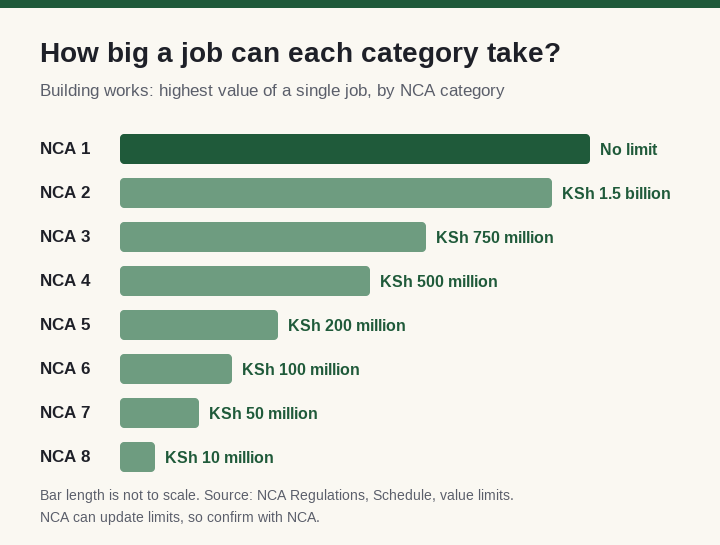
The Regulations say the scope and cost of works can be updated by the Authority from time to time[5]. So confirm the current limit with NCA before you bid near the edge of your category.
Two more rules worth knowing:
- NCA 2 to NCA 8 are for local contractors only. Foreign contractors can register only as NCA 1[5].
- You can upgrade. Apply with proof of the construction work you’ve done, and NCA reassesses you[5].
How do you register with NCA, step by step?
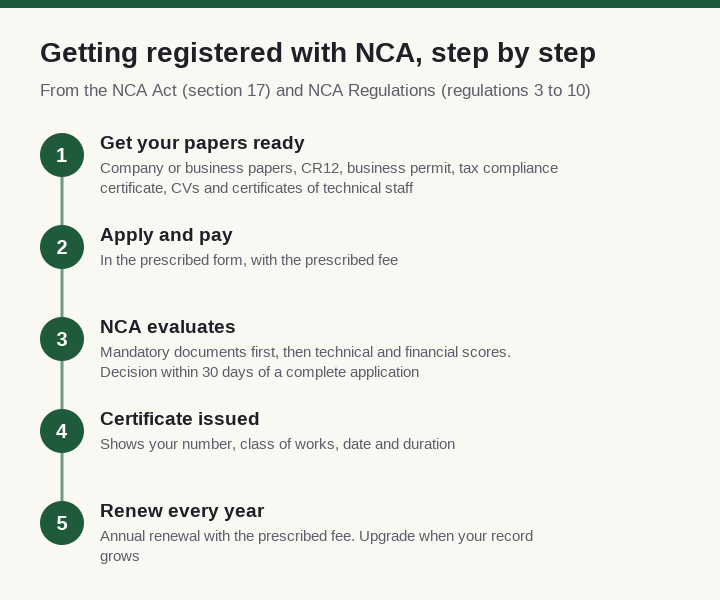
You apply to NCA in the prescribed form, with the prescribed fee and your documents[3][5]. Here’s the order that saves time.
- Register the business first. You need your company or business registration papers before NCA will look at you. Our guide on registering a business in Kenya walks you through it.
- Collect the mandatory documents. The Schedule lists the application fee receipt, your business name, address and contacts, certificate of incorporation or registration, a valid business permit, CR12, valid work permits for any foreign staff, the completed form with all annexes, a declaration signed, witnessed and stamped, a tax compliance certificate, and referees[7].
- Prepare your technical file. For a firm, at least one director or partner must hold the technical qualifications or experience NCA sets[1]. Add staff certificates and CVs, proof you own your plant and equipment, and past projects with completion certificates[7].
- Prepare your financial file. The Regulations ask for financial statements for the period before you apply, or proof of a bank account in the company’s name[5]. NCA’s financial score is based on audited accounts, so have them ready[7].
- Apply and pay. If you apply online, the Regulations say supporting documents NCA asks for go by registered mail or hand delivery[5]. Your application isn’t complete until NCA has everything.
- Wait for the decision. NCA must decide within 30 days of a complete application and give reasons if it rejects you[5].
- Collect your certificate. It shows your registration number, class of works, date and duration of registration[3].
Not happy with your category?
You can petition NCA in writing. NCA must answer within 30 days[5].
If you’re still not satisfied, you can go to the Appeals Board within 30 days, and then the High Court within 30 days of the Appeals Board’s decision[5].
How do you keep your registration active?
Renew every year. The Regulations require an annual application for renewal, with the prescribed fee[6]. Send it at least 30 days before your licence expires[6].
Each year, the director or partner with the technical qualifications must also attend at least one Continuous Professional Development (CPD) event recognised by NCA. NCA considers this when you renew or upgrade[6].
Missing renewals has real consequences. The Act lets the NCA Board delete a contractor who fails to pay annual subscription fees for two consecutive years[3]. A deleted contractor must surrender the certificate and can’t register afresh under another name[3].
Keep your address current too. The Board can delete a contractor who doesn’t respond within six months to a registered letter asking for a current address[3].
Tip: clients can check you. NCA publishes registered contractors in the Kenya Gazette after the 1st of January and the 1st of June each year, and anyone may inspect the register[3]. A Gazette listing is accepted as prima facie evidence that you are registered[3].
What does NCA registration cost?
The fees are set by NCA and published in the Kenya Gazette. The Regulations say the Authority sets its fees with the Cabinet Secretary’s approval[8].
Registration, renewal and upgrading each carry their own prescribed fee[3][6][5]. Check NCA’s current gazetted fee schedule before you budget. We don’t quote a figure here because fees change by Gazette notice[8].
Budget for these too:
- Tax compliance certificate: you need a valid one for the mandatory documents[7].
- Business permit from your county[7].
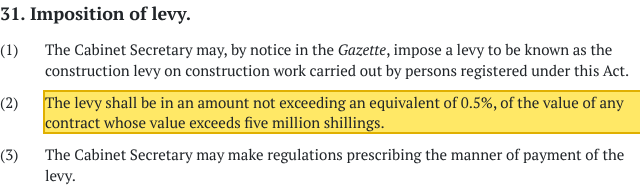
- Construction levy on big jobs. The NCA Act allows a levy of up to 0.5% of the value of any contract above KSh 5 million[4].
- Time. Allow at least 30 days from a complete application[5], plus the time to gather documents.
Who registers the project, you or the client?
The owner does. The NCA Regulations say every construction project, public or private, is registered with NCA[8].
The owner applies within 30 days of awarding the contract, and before work starts[8]. NCA then registers the project and issues a compliance certificate[8].
Here’s why it matters for your money. After registration, the owner must report to NCA on the contract’s progress, including whether all payments owing to the contractor have been settled[8].
So ask for the project’s NCA compliance certificate before you mobilise. A registered project has a paper trail if payment becomes a dispute.
How do you get paid on time on a construction job?
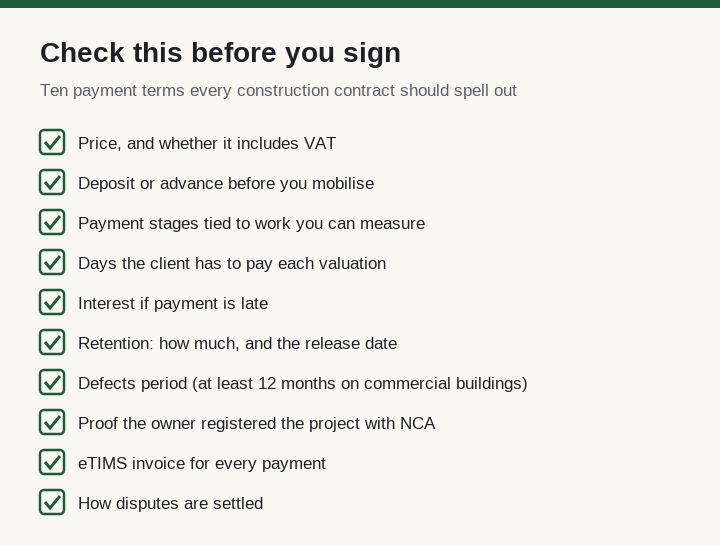
Fix payment in the contract before the first bag of cement arrives. Clear written terms give you something firm to point to when a payment is late.
Here’s what works in practice.
Agree payment stages tied to measurable work
Split the job into stages you can both see: foundation, walling to ring beam, roofing, finishes.
Name the amount for each stage and the number of days the client has to pay after you finish it. “Paid on completion of roofing, within 14 days” is clear. “Paid as work progresses” is not.
Take a deposit before you mobilise
Ask for a deposit or advance that covers materials and the first weeks of labour.
Never fund a client’s project from your own working capital without a written payment schedule.
Get every valuation signed
When a stage is done, measure it, write it up and get the client or their consultant to sign.
A signed valuation is hard to argue with later. A WhatsApp photo is not a valuation.
Agree retention and the release date
Many contracts hold back part of each payment as retention until defects are fixed. If yours does, write down how much is held and the exact date it is released.
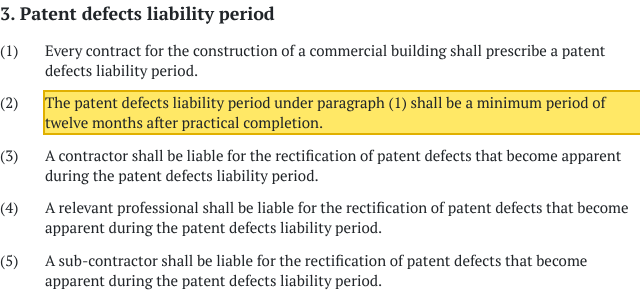
For commercial buildings, the Defects Liability Regulations set a patent defects period of at least 12 months after practical completion[9]. Practical completion means the county has issued a certificate of occupation[9].
The same Regulations set a latent defects period of at least six years after that, and require the contractor to insure for latent defects[9]. Price that insurance into commercial jobs.
Put interest for late payment in the contract
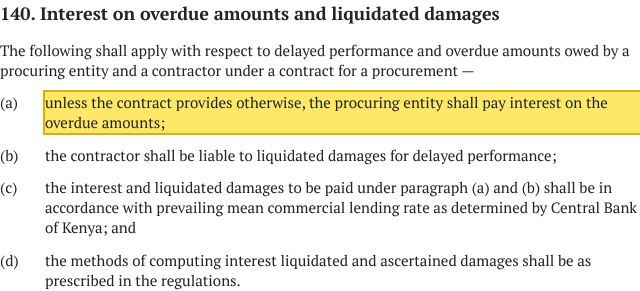
For jobs from public bodies, such as national and county government and state agencies, the law helps you. The Public Procurement and Asset Disposal Act says that unless the contract provides otherwise, the procuring entity shall pay interest on overdue amounts[10].
That interest follows the prevailing mean commercial lending rate set by the Central Bank of Kenya[10]. The same Act makes it an offence to delay payment of contractors beyond the contractual period without justifiable cause[10].
It cuts both ways: if you finish late, you are liable for liquidated damages at the same rate[10].
The Procurement Act doesn’t cover private clients, so write your own late-payment interest clause, with the rate and the day it starts.
Issue an eTIMS invoice for every payment
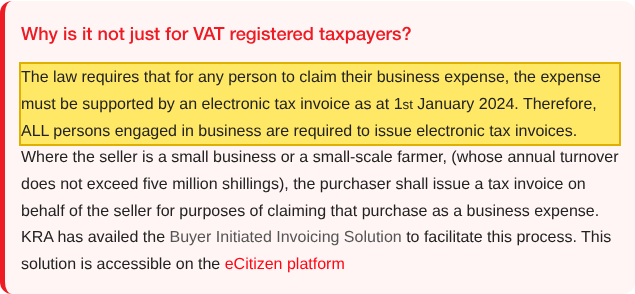
KRA says that since 1 January 2024, a business can only claim an expense if it is supported by an electronic tax invoice[13].
Your business client needs that invoice to claim your bill as an expense, so send one with every valuation. If your annual turnover is KSh 5 million or less, KRA lets the buyer issue the invoice on your behalf instead[13]. Our free invoice generator helps you lay out a clean draft first.
Why is the client’s payment smaller than your invoice?
Usually withholding tax. Many clients must deduct tax from what they pay you and send it to KRA.
KRA’s rate for contractual fees paid to residents is 3%[11]. The payer remits it within five working days and KRA sends a withholding certificate to the email on your iTax account[11]. KRA lists resident contractual fees of KSh 24,000 or less in a month as exempt from withholding tax[11].
If you are VAT registered and your client is a withholding VAT agent, 2% of the taxable value is also withheld as VAT[12].
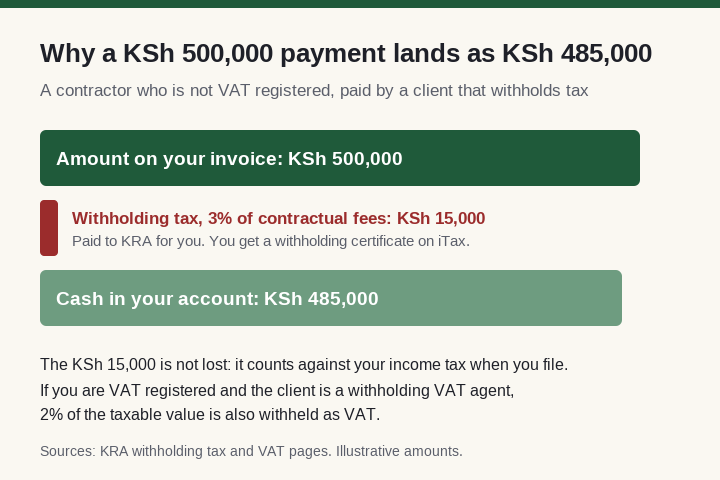
That money isn’t lost. KRA says withholding tax is usually not a final tax for residents: you declare the income and the certificates in your return[11].
Tip: match every short payment to a certificate on iTax. KRA sends the certificate only once your client has paid the tax over[11], so a missing one means the money was deducted but may not have reached KRA. Follow it up with the client.
Plan your cash flow around the net figure, not the invoice. Our guide on managing cash flow shows how.
What do you need before you take a construction job?
- A current NCA certificate in the right class and category[3]
- A tax compliance certificate and county business permit[7]
- A written contract with payment stages, deposit, days to pay, retention and interest
- The project’s NCA compliance certificate from the owner[8]
- eTIMS set up to invoice every valuation[13]
- A plan for withholding tax in your cash flow[11]
What habits help contractors get paid?
- Diarise renewals in the same calendar as your KRA dates. Our KRA deadline calendar lists them.
- Keep every completion certificate. NCA scores past projects only with documentary support[7], and upgrading needs proof of work[5].
- Join a contractors’ association. NCA may ask for proof of membership[5].
- Send a statement every month to clients who owe you. A clear running balance gets paid faster than a pile of loose invoices.
- Check public tenders for jobs in your category on our tenders page.
What should you never do?
- Don’t bid on a job above your category’s value limit.
- Don’t start work on a verbal promise of payment.
- Don’t let your registration lapse while a job is still running.
- Don’t hand over the keys before the final valuation is signed.
- Don’t ignore a missing withholding certificate.
What mistakes cost contractors money?
Pricing without the deductions. You quote KSh 500,000 and plan to spend KSh 500,000, then KSh 485,000 arrives. Instead, plan from the net amount.
One big payment at the end. If the client delays, you’ve financed their whole project. Instead, agree stage payments with dates.
Vague retention. “We’ll release it later” can mean never. Instead, write the amount and the release date.
Thinking the client handles NCA. Your own registration and renewal are yours. The project registration is the owner’s, but check it was done.
Losing paperwork. Completion certificates and signed valuations are your evidence for both upgrades and disputes. Scan and store them as you go.
What should be on your NCA and payment checklist?
- NCA certificate current, right class and category.
- Renewal date in your calendar.
- Tax compliance certificate and business permit valid.
- Contract signed with stages, deposit and days to pay.
- Retention amount and release date written down.
- Late-payment interest clause included.
- Project NCA compliance certificate seen.
- eTIMS invoice sent with every valuation.
- Withholding certificates matched on iTax.
- Completion certificates filed for your next upgrade.
This guide is general information, not legal advice. For a payment dispute or a contract worth a lot of money, speak to an advocate. More for builders on our construction industry page.
If your business is registered and ready, make sure buyers looking for contractors can find you on Biashara Pros.
Common questions
Do I need NCA registration to build my own house?
Not for a simple one. The NCA Act says a person is not treated as a contractor where the work is a residential house for private use that does not need a structural design. If your house needs a structural design, whoever you pay to build it must be registered with NCA.
Can a sole proprietor register with NCA, or only a company?
The NCA Act allows a person or a firm to apply. For a firm, at least one partner or director must hold the technical qualifications, skills or experience the NCA Board sets.
How long does NCA take to decide on an application?
The NCA Regulations say the Authority decides within thirty days of receiving a complete application, with reasons if it rejects. An application is not complete until all documents are received.
What happens if I do not renew my NCA registration?
Registration is renewed every year. Under the NCA Act, the Board may delete a contractor from the register for failing to pay annual subscription fees for two consecutive years, and a deleted contractor must surrender the certificate.
Can a foreign company register as NCA 3?
No. The NCA Regulations open NCA 1 to both local and foreign contractors, but restrict NCA 2 to NCA 8 to local contractors only.
Who pays the construction levy?
The NCA Act lets the Cabinet Secretary impose, by Gazette notice, a construction levy of up to 0.5% of the value of any contract worth more than five million shillings, on work by registered contractors. The Act itself does not say whether the owner or the contractor pays, so check the current Gazette notice with NCA and state in the contract who carries it.
Is withholding tax a final tax for a Kenyan contractor?
No. KRA says withholding tax is usually not a final tax for resident payees. You declare the income and the withholding certificates in your return and pay any balance, or use the credit against what you owe.
Sources
- National Construction Authority Act (Cap. 118), section 15 (requirement for registration), Kenya Law
"A person shall not carry on the business of a contractor unless the person is registered by the Board under this Act. ... a fine not exceeding one million shillings, or to imprisonment for a term not exceeding three years or to both"
- National Construction Authority Act (Cap. 118), section 16 and Third Schedule (meaning of contractor, classes of works), Kenya Law
"Provided that a person shall not be deemed to be a contractor if the work undertaken ... consists of a residential house for private use, not requiring a structural design."
- National Construction Authority Act (Cap. 118), sections 17, 20, 21 and 25 (certificate, Gazette lists, inspection, deletion), Kenya Law
"Upon registration, the person shall be issued with a certificate of registration indicating the registration number, the class of works for which registered, the date of registration and duration of registration."
- National Construction Authority Act (Cap. 118), section 31 (construction levy), Kenya Law
"The levy shall be in an amount not exceeding an equivalent of 0.5%, of the value of any contract whose value exceeds five million shillings."
- National Construction Authority Regulations, regulations 3, 4, 6, 8, 9 and 10 (application, evaluation, exemption, review, restriction, upgrading), Kenya Law
"The Authority shall make a decision on an application by a person or firm within thirty days of receiving such application"

- National Construction Authority Regulations, regulations 7, 13 and 14 (renewal, renewal timing, CPD), Kenya Law
"A person or firm shall submit an annual application for renewal of the certificate of registration ... Application for renewal of the licence shall be submitted to the Authority in writing at least thirty days before the expiry of such licence."

- National Construction Authority Regulations, Schedule Parts I to V (mandatory requirements, scoring, categories and value limits), Kenya Law
"VALUE LIMITS ... Building Works NCA 1 UNLIMITED NCA 2 1,500,000,000.00 ... NCA 8 10,000,000.00"
- National Construction Authority Regulations, regulations 17 and 27 (registration of construction works, fees), Kenya Law
"An owner shall make an application for registration of a project to the Authority in writing within thirty days from the date on which a tender for construction works, contract or project is awarded"

- National Construction Authority (Defects Liability) Regulations, regulations 3, 5 and 6, Kenya Law
"The patent defects liability period under paragraph (1) shall be a minimum period of twelve months after practical completion."
- Public Procurement and Asset Disposal Act (Cap. 412C), sections 140 and 176, Kenya Law
"unless the contract provides otherwise, the procuring entity shall pay interest on the overdue amounts"
- KRA: Withholding tax (rates, remittance, certificates)
"Contractual (from 1 July 2003) 3% ... Withholding tax shall be deducted and remitted to the Commissioner within 5 working days after the deduction is made ... Resident management, professional, training and contractual fees whose aggregate value is Ksh 24,000 and below in a month."

- KRA: Value Added Tax (withholding VAT)
"Withholding VAT is charged at a the rate of 2% of the value of taxable supplies with effect from 07/11/2019."

- KRA: What is eTIMS
"The law requires that for any person to claim their business expense, the expense must be supported by an electronic tax invoice as at 1st January 2024."
This is general information, not advice for your situation. Rules and rates change with each Finance Act. Before a decision with real money at stake, confirm with a licensed accountant or advocate. Spotted something out of date? Tell us at [email protected] and we will fix it.