What should you check before buying beauty products in bulk?
Check five things before any bulk beauty order: a valid KEBS mark, that the product is not on the KEBS banned list, a complete label with batch number and expiry date, a supplier you can trace, and a proper invoice. Each check takes minutes. Skipping one can cost you a whole carton, a customer or a fine.
Why it matters more for beauty than for most stock: these products go on skin, scalp and nails. If a relaxer burns or a lotion causes a rash, the client blames the salon or the shop that sold it, not a distributor they have never met. Your name is on the line every time.
December and January are busy months for hair, skin and nail products, with weddings, end-year parties and back-to-school all in the same weeks. When you are restocking in a hurry, these checks matter even more.
Before every bulk order:
- 1. Check the KEBS mark on a sample from the actual stock[1][2]
- 2. Check every product name against the KEBS banned list[3]
- 3. Read the full label on the sample and on the cartons
- 4. Compare price lists from two or three suppliers, per ml or per gram
- 5. Place a small trial order and watch how it sells
- 6. Pay to a business till or paybill and check the eTIMS invoice[10][11]
How do you check a KEBS mark?
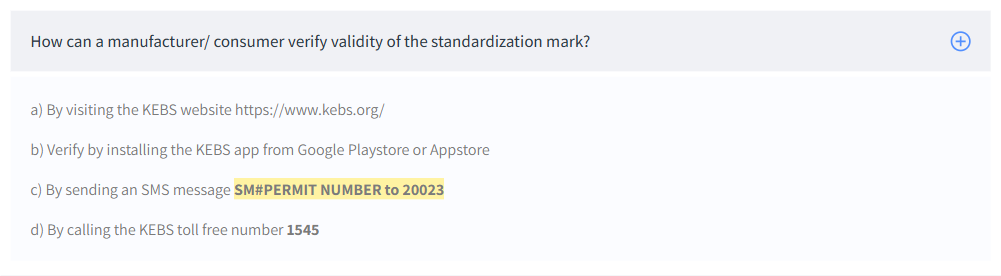
You can check a KEBS mark by SMS in about a minute. The Kenya Bureau of Standards (KEBS) is the government body that sets and enforces product standards in Kenya, including the standards for cosmetics.
Products made in Kenya that meet the Kenyan standard carry the Standardization Mark (S-Mark) with a permit number under it. KEBS says the S-Mark permit is valid for 2 years and is renewable[1], so a product showing an old permit number may no longer be covered.
Imported products carry an Import Standardization Mark (ISM) sticker. KEBS tells consumers to verify it by SMS, and the reply shows the importer's name and whether the mark is valid or invalid[2].
Some products also carry the Diamond Mark (D-Mark). KEBS describes it as a voluntary product certification mark of excellence for both locally made and imported products, valid for 4 years[1].
Check the number on the actual tub or bottle you are buying, not on a photo the supplier sends. A real permit number can be printed on a fake product, so the SMS check works best together with the label and packaging checks below.
Use any of these before you pay:
Which beauty products are banned in Kenya?
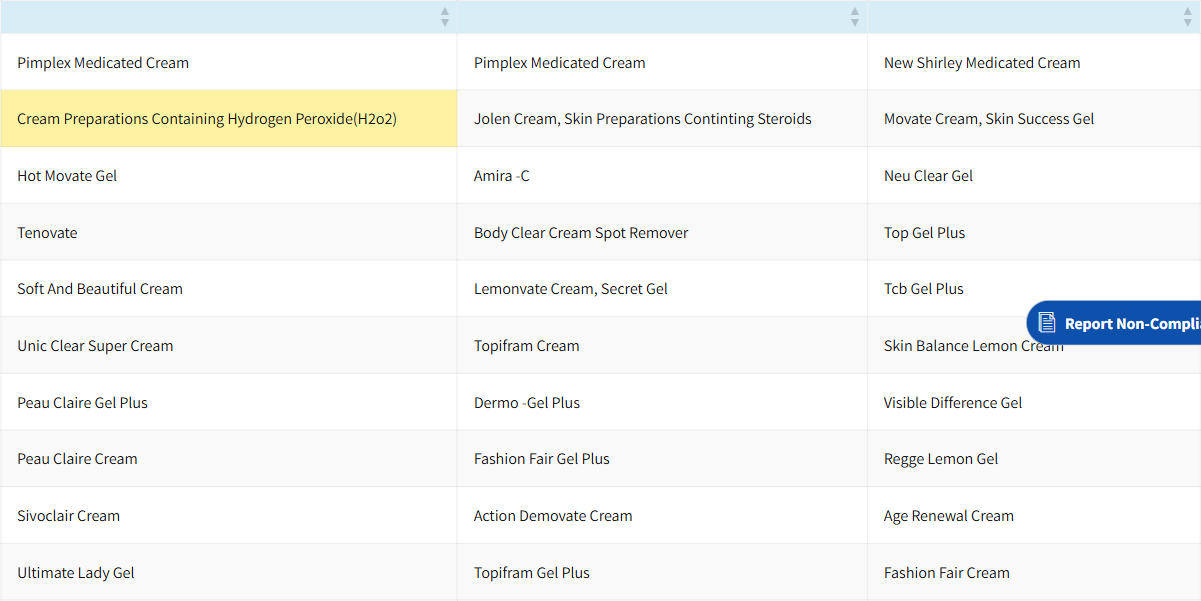
KEBS publishes a banned products list, and beauty buyers should read it before every big restock[3]. It names dozens of skin lightening lotions and creams. Names on the list include Peau Claire Beauty Body Lotion, Jaribu Skin Lightening Lotion, Movate and Tenovate, and several "gel plus" products[3].
The list also includes two category entries: skin preparations containing steroids, and cream preparations containing hydrogen peroxide[3]. Stocking anything on the list puts your clients and your business at risk. The KEBS page carries no date, so check the live list before each order.
Adding mercury to cosmetics is banned under the Minamata Convention on Mercury, the international treaty on mercury[7]. In 2023 the parties removed the old limit of 1 part per million, making it explicit that no mercury can be added to cosmetics, including skin lightening soaps and creams[8]. The World Health Organization calls mercury-containing skin lightening products hazardous to health, and also warns about hydroquinone in these products[9].
Be careful with products sold mainly on a promise of fast, strong lightening, and check the KEBS list for:
How do you spot a fake beauty product?
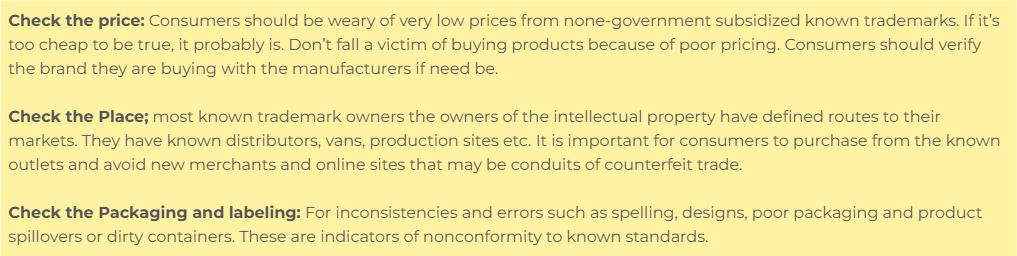
The Anti-Counterfeit Authority (ACA), set up under the Anti-Counterfeit Act of 2008, tells buyers to check four things it calls the 4 Ps: price, place, packaging and personal experience[5].
Price. If a well-known brand is far cheaper than everywhere else, ask why. The ACA puts it simply: if it is too cheap to be true, it probably is[5].
Place. The ACA notes that big brands sell through known distributors, and advises buying from known outlets rather than new merchants and online sites that may carry fakes[5]. Ask suppliers where their stock comes from.
Packaging. Compare with a piece you know is genuine. The ACA lists spelling mistakes, poor packaging, spills and dirty containers as signs of a product that does not meet standards[5].
Personal experience. The ACA tells buyers to trust their sense of smell, touch and sight[5]. You and your stylists know how a product should look, smell and feel. If the consistency, scent or colour is off, stop using the batch.
A genuine label tells you who made the product and when. On the sample and on every carton, look for:
- A batch or lot number
- A manufacturing date and an expiry date (or a "use within" period after opening)
- A full ingredient list
- The maker's or importer's name and physical address
- The KEBS mark with its permit or sticker number
What must you have before you pay a supplier?
Have these in hand before any money moves. If a supplier will not give you one of them, treat that as your answer.
Before you pay:
- A written price list or quote, with brand, size, quantity and unit price for every item
- A KEBS check you did yourself on a sample from the actual stock
- Expiry dates for the stock you will receive, not only for the sample
- Delivery date, delivery cost and who pays for transport
- A returns rule in writing for damaged, expired or wrong items
- The supplier's business name, physical location and a business till or paybill number
- An eTIMS invoice once you pay
How do you compare supplier price lists fairly?
Ask two or three suppliers to price the same list: the same brands, the same sizes and the same quantities. Prices only compare properly when everything else matches.
Work out the price per millilitre or per gram, because pack sizes differ. For example (illustrative prices, not a market quote), a 500 ml tub at KSh 900 works out at KSh 1.80 per ml, while a 250 ml tub at KSh 500 is KSh 2.00 per ml. The bigger tub is cheaper per use, as long as you will finish it before it expires.
Then add what the price list leaves out: delivery to your shop, any minimum order, and how long the stock has left before expiry. A low price on stock that expires in two months is not a bargain if you sell slowly.
Ask each supplier the same questions: Are you the brand's authorised distributor? How long is left on the expiry dates? What happens if a carton arrives damaged? Clear, quick answers are a good sign. Vague answers are not.
Small habits that save money:
- Ask the supplier for photos of the actual cartons showing batch numbers and expiry dates before you pay
- Keep every M-Pesa confirmation message in one folder or chat
- Reorder slow sellers in smaller amounts, more often
- Note which supplier handled a problem well, and give them the next order
How should you test a new supplier?
Start small. Place a first order big enough to test the products with real clients, but small enough that you can afford to lose it. Then grow the order once the stock sells and clients come back for more.
Use the trial to check more than the product. Did it arrive on the day promised? Did it match the quote? Was everything sealed and in date? How did the supplier handle a missing or damaged item? The way a supplier handles the first problem tells you how they will handle a big one.
For a salon, follow the maker's instructions and keep notes on any client reaction. For a shop, watch whether clients return to buy again. Repeat buying is a good sign that a product works.
How should you pay, and what paperwork protects you?
Pay to a business till or paybill in the supplier's registered business name, not a personal number you were sent on WhatsApp. Keep every M-Pesa message.
Ask for an eTIMS invoice, the electronic tax invoice registered with the Kenya Revenue Authority (KRA). You can confirm it is genuine by scanning its QR code or entering the invoice number on the KRA invoice checker[10][11]. A real invoice protects you in a dispute and keeps your own expense records clean for tax.
For a large order, agree staged payments in writing: a deposit to confirm the order and the balance on delivery, after you have checked the stock. Avoid paying the full amount upfront to a supplier you have never bought from.
What does checking cost, and how long does it take?
KEBS lists its 1545 line as toll-free[1]. For the SMS checks to 20023, ask your mobile network for its SMS rate. Each check takes about a minute.
Know how long marks last: the S-Mark permit for 2 years and the D-Mark for 4 years[1]. A permit that has passed its date needs a question to the supplier before you buy.
Checking an eTIMS invoice on the KRA invoice checker is free[10]. A trial order adds a few days before your bulk order, so plan December restocks with that time in mind.
Don'ts: what to avoid when buying beauty stock
A few habits cause most losses. Avoid them every time, even with a supplier you like.
Do not:
- Buy any product on the KEBS banned list, even if clients ask for it by name[3]
- Accept a photo of a KEBS number instead of checking the real product
- Pay the full amount upfront to a new supplier
- Pay to a personal number when the supplier says they have a business
- Buy stock without seeing the expiry dates on the actual cartons
- Repackage or decant products into unlabelled containers for sale
- Ignore a change in smell, colour or texture in a new batch[5]
Common mistakes, and what to do instead
Buying the cheapest list without checking why. Instead, ask what makes it cheaper and check the expiry dates and source. A very low price on a big brand is one of the ACA's warning signs[5].
Checking the sample but not the delivery. Instead, check labels, seals and expiry dates on the cartons you actually receive, before you sign for them.
Ordering too much of a slow seller. Beauty products expire. Instead, order in amounts you can sell well before the expiry date, and reorder more often.
No written terms. A voice note is hard to rely on in a dispute. Instead, get the price list, delivery date and returns rule in writing, even as a simple message you can screenshot.
Storing stock badly. Instead, follow the storage instructions on each label and keep stock in a cool, dry place.
What should you do if you bought fake or banned products?
Stop selling or using them straight away, and keep them. The ACA advises that the product itself is your proof[5].
Tell the seller you received counterfeit goods and ask for a refund, as the ACA advises[5]. Keep your M-Pesa messages, invoice and chats.
Report it. The ACA takes reports through its "Report a counterfeit" portal and complaint form on aca.go.ke, and on its toll-free line 0800 211 237[5][6]. For a product that does not meet standards, use the "Report Non-Compliant Product" link KEBS gives on its market surveillance site (the portal may ask you to sign up), or call 1545[4][1]. You can also tell the brand owner[5].