
How do you compare supplier quotes fairly?
You compare quotes fairly by making sure they price the same job, then comparing the full amount you will pay, delivered, against what each supplier promises on timing, payment, warranty and paperwork.
The cheapest number on the page only matters once everything behind it matches.
You know the feeling. Three quotes land on WhatsApp: one is a photo of a handwritten note, one is a neat PDF, one is a voice note with a figure in it.
They look like three prices for one job. Very often they are three prices for three different jobs.
This guide gives you seven questions to put to every quote. They work for stock, office furniture, printing, catering, repairs, building work, almost anything you buy from a business.
Ask them before you choose, not after the goods arrive. Here is the whole list on one page.
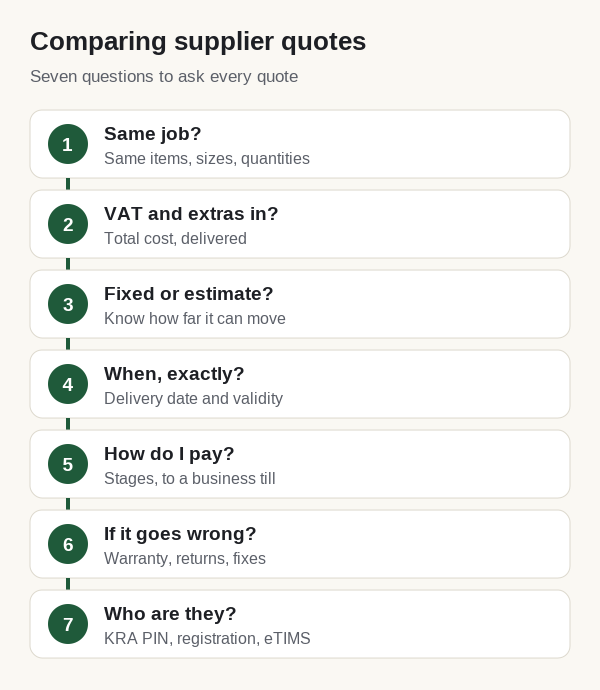
To compare quotes without missing anything:
- 1. Write one clear request and send the same one to every supplier
- 2. Ask for itemised quotes in writing, with a date they are valid until
- 3. Turn every quote into one total: price, VAT, delivery and extras[2]
- 4. Note whether each one is a fixed price or an estimate[1]
- 5. Line up delivery dates, payment stages and warranty terms
- 6. Check the supplier: KRA PIN, registration and eTIMS invoice[3][4][5]
- 7. Choose on value, then confirm the winning quote in writing
Question 1: Are they all quoting for the same job?
Start here, because nothing else compares until this does.
Read each quote line by line. Is it the same item, the same size, the same brand or grade, the same quantity?
A printing quote for 500 calendars on light paper is not the same as one for 500 on heavy board. A furniture quote for chairs without arms is not the same as one with arms.
The easy fix is to send one written request to everyone. List what you need, how many, any size or quality you insist on, where it must be delivered and by when.
Then ask each supplier to reply against that list. A good supplier will do it gladly, and will tell you if something on your list is a bad idea.
If a supplier offers a different product, ask them to quote your original as well. You can still take their suggestion, but now you know what it costs against the others.
Watch for vague lines like "assorted items", "materials" or "labour" with one lump sum. Ask for them to be broken down.
Question 2: Are VAT, delivery and extras included?
This is where most comparisons go wrong. Two quotes can look KSh 15,000 apart and end up the other way round once the extras go in.
Value Added Tax (VAT) is the tax added to most goods and services sold in Kenya. KRA says the general rate is 16% on all taxable goods and services other than zero-rated supplies[2].
Not every supplier charges VAT. KRA says a business must register for VAT once its taxable supplies reach KSh 5 million or more in a year[2], so a smaller supplier may not add it at all.
So look for the words on each quote: "incl. VAT", "excl. VAT", "+VAT", or nothing. If it says nothing, ask.
Then look for everything else that might be added later: delivery, loading, installation, setup, transport for the crew, packaging, design fees, or a charge for small orders.
Ask each supplier one simple question: "What is the total I will pay, delivered to my door, with nothing else added?"
Here is an example with made-up numbers to show the effect.
Quote A says KSh 100,000 plus KSh 5,000 delivery, both before VAT. Add 16% and the total is KSh 121,800[2].
Quote B says KSh 115,000 including VAT and delivery. Quote B is KSh 6,800 cheaper, even though its headline price looked higher.
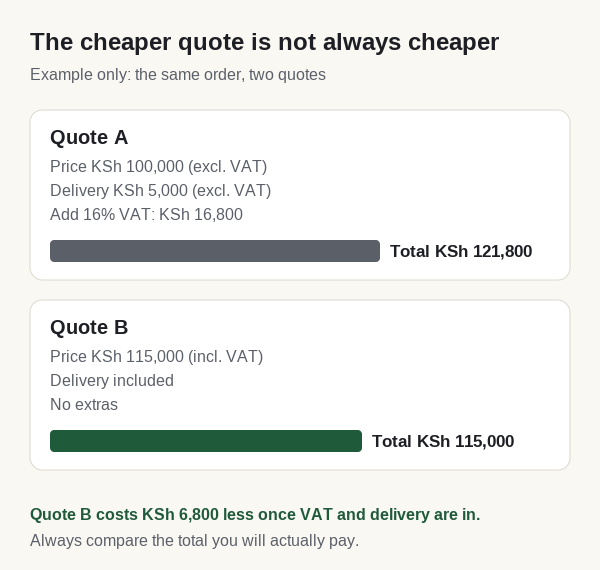
When a quote is before VAT:
- Multiply the pre-VAT total by 1.16 to get the total with 16% VAT[2]
- If VAT applies to delivery too, add delivery before you multiply
- Ask a supplier who does not charge VAT to confirm that in writing on the quote
Question 3: Is this a fixed price or an estimate?
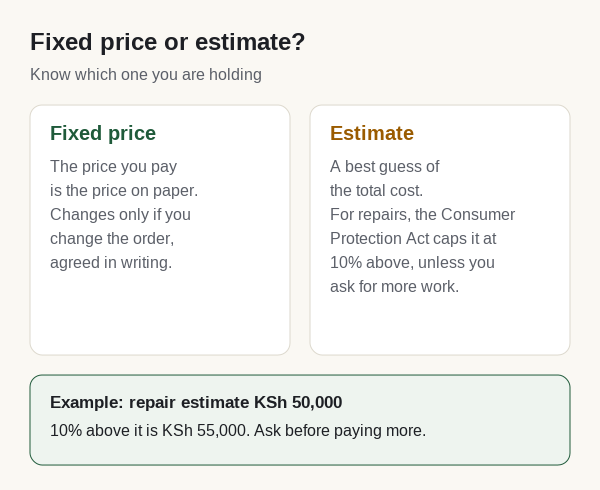
A fixed price is what you pay, unless you change the order. An estimate is the supplier’s best guess of the total cost.
Estimates are normal for repairs, building work and anything where the full job only shows once work starts. The point is to know which one you are holding.
Kenya’s Consumer Protection Act, 2012 sets a limit for repairs. It defines an estimate as one for "the total cost of work on and repairs to the goods being repaired"[8].
If a consumer agreement includes such an estimate, the supplier shall not charge more than ten per cent above it[1].
So on a KSh 50,000 repair estimate, the most you should be charged is KSh 55,000, unless you ask for more work[1].
If they do charge more than that, the Act says the consumer may require the supplier to provide the goods or services at the estimated price[1].
The Act also says nothing stops you and the supplier agreeing to change the estimate or price if you ask for more or different goods or services[1]. So extras you ask for can change the price.
For building work, events and other jobs, the Act may not clearly cover the estimate. Ask the supplier to write a cap on the quote, such as "final price no more than 10% above this estimate without my written approval".
Who counts as a consumer? The Act’s definition includes a person who has entered into a transaction with a supplier in the ordinary course of the supplier’s business, unless the transaction is exempt[1].
If you are not sure the Act covers your deal, ask an advocate before you rely on it.
In practice: when a quote says "estimate", "approximately" or "from", ask the supplier to write down what could push the price up, and to call you before going over.
Question 4: When will it arrive, and how long is the price valid?
A quote without a date is only half a quote. Ask for two dates on every one.
The delivery or completion date. Not "soon" or "within the week", but a day. For a job in stages, a date for each stage.
The date the quote expires. Prices for stock, fuel and imported goods move, so suppliers often hold a price for a short time. If you take two weeks to decide, the price may change.
December makes this sharper. Printers, caterers, tailors and transporters are all busy in the same weeks, so a supplier who can deliver on your date may be worth more than one who is slightly cheaper but can’t.
Ask what happens if they are late. Is there a discount, a free delivery, the right to cancel? Many small suppliers won’t offer penalties, but the answer tells you how seriously they take the date.
Then compare like for like. If you need the goods by 15 December, a quote that delivers on 20 December is not a cheaper quote. It is a quote for a different job.
Question 5: How do they want to be paid?
Payment terms are part of the price. KSh 100,000 with half on delivery is safer for you than KSh 95,000 all upfront to someone you have never bought from.
Look at each quote for the deposit, when the balance is due, and how you pay.
Staged payments protect both sides: a deposit to confirm the order, more when goods leave or work reaches a stage you can see, and the balance after you check what you received.
Pay to a business till, paybill or bank account in the supplier’s business name. Be careful when you are asked to send business payments to a personal number shared on WhatsApp.
Ask whether they will issue an eTIMS invoice, the electronic tax invoice that goes through the Kenya Revenue Authority (KRA).
KRA says TIMS and eTIMS invoices carry a QR code you can verify with a QR reader, and you can also use the invoice checker[4][5].
If you run a business, a valid invoice matters for your own records and tax. If you are buying for yourself, it is still your best proof of what you paid for.
Question 6: What happens if something goes wrong?
Every supplier sounds reliable before you pay. The quote should say what happens if they are not.
Ask about three things: the warranty (how long, and what it covers), returns (wrong, damaged or faulty items), and fixes (who pays to put right poor work, and how fast).
The law gives you a floor. The Consumer Protection Act says the implied conditions and warranties of the Sale of Goods Act (Cap. 31) apply to goods supplied under a consumer agreement[1].
It also says any term that tries to cancel or vary those implied conditions or warranties is void[1]. So a line in small print saying "no returns under any circumstances" may not hold in a consumer agreement.
Still, a clear written promise beats arguing about the law later. Choose the supplier whose answer is specific: "12 months on parts and labour, replaced within 7 days", not "we stand by our work".
If a dispute does come, the Judiciary says the Small Claims Court deals with civil and commercial disputes whose value does not exceed KSh 1 million, in a simple and cost-efficient way[7].
Your written quote, invoice and M-Pesa messages are your evidence.
Question 7: Can you check who the supplier is?
Before money moves, make sure the business is real and is who it says it is. It takes a few minutes.
KRA PIN. Ask for the supplier’s KRA PIN and put it into the iTax PIN Checker. KRA says the checker confirms whether a PIN is genuine, generated by its system and in active status[3].
Business registration. Run a business search on eCitizen to see that the name on the quote is a registered business. The buyer guide "The 2-Minute eCitizen & BRS Check" on this site walks you through it.
Name match. The name on the quote, the till or paybill, the PIN and the registration should all line up. If they don’t, ask why before you pay.
Physical address. Ask where they operate from, and visit if the order is big.
eTIMS invoice. Once you pay, scan the QR code or use the invoice checker to confirm it is genuine[4][5].
None of these checks proves a supplier is good at the work. They prove you know who you are dealing with, which is where trust starts.
Why is the lowest price not always the best value?
Because price is only one part of what you are buying. Even the government doesn’t simply pick the cheapest tender.
Kenya’s Public Procurement and Asset Disposal Act, 2015 says the successful tender is the one that meets the method set in the tender document[6].
That method can be the tender with the lowest evaluated price or the lowest evaluated total cost of ownership[6].
In plain terms, an evaluated price is judged against the criteria in the tender document, not just read off the page.
You can borrow that thinking for a small order. Total cost of ownership means what the item costs you over its life, not just on the day: delivery, setup, repairs, replacement and the cost of things going wrong.
A cheaper printer that needs expensive ink, a cheaper tent that arrives late on the wedding day, cheaper chairs that break in six months: none of these is really cheaper.
So once your quotes are lined up, ask: which one gives me what I need, on time, with the least risk, for a fair total? That is often not the lowest number.
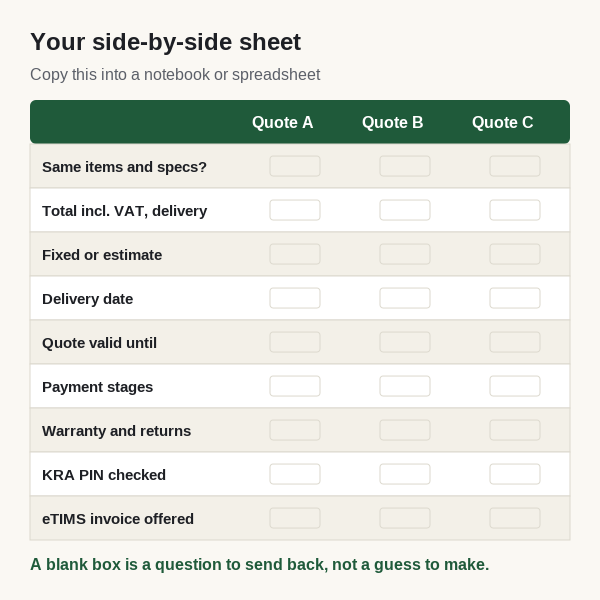
What must you have before you choose a quote?
Have these in hand before you say yes. If a supplier won’t give you one of them, that is useful information too.
Before you choose:
- A written, itemised quote for each supplier, replying to the same request
- One total per quote with VAT, delivery and every extra included[2]
- A clear note of fixed price or estimate, and what could change an estimate[1]
- A delivery or completion date, and the date the quote expires
- Payment stages and the business till, paybill or bank account you will pay to
- Warranty, returns and fix terms in writing
- A KRA PIN you checked yourself on the iTax PIN Checker[3]
- Confirmation that they will issue an eTIMS invoice[4]
What tips help when buying from Kenyan suppliers?
A few habits make comparing quotes much easier.
Ask on WhatsApp, decide on paper. Chatting is fine, but ask for the final quote as a PDF or a clear photo of a stamped quote, so nothing is lost in a long thread.
Ask for three quotes, not ten. Three is enough to see the normal price and spot one that is far off. More than that and you spend days chasing replies.
Give a quotes-by date. Tell suppliers when you need their quote. The serious ones meet it, and you are not left waiting on the slowest.
Save M-Pesa messages. Keep every confirmation message in one place with the quote and invoice.
Ask the question you are afraid to ask. "Why is yours KSh 20,000 cheaper?" A good supplier has a clear answer. A vague answer is also an answer.
Negotiate on the right thing. Sometimes a better payment plan, free delivery or a longer warranty is worth more than a small discount.
What should you avoid when comparing quotes?
These habits cause most of the regret. Avoid them even when you are in a hurry.
Do not:
- Compare a price before VAT with a price that includes VAT[2]
- Choose on a verbal price or a voice note with no written quote behind it
- Accept "assorted", "materials" or "labour" as one lump sum without a breakdown
- Pay a big deposit to a supplier whose PIN or registration you have not checked[3]
- Send business payments to a personal number when the supplier says it has a business
- Let a quote expire while you decide, then act surprised when the price changes
- Sign anything that says you give up your right to return faulty goods[1]
What mistakes do buyers make when comparing quotes?
Comparing headline prices. The first number is rarely the total. Instead, turn every quote into one delivered total before you compare.
Sending different requests to different suppliers. You end up with quotes for different jobs. Instead, write one request and send the same one to everyone.
Treating an estimate like a fixed price. Then the bill surprises you. Instead, ask which one it is and what could push it up.
Ignoring the date. A cheap quote that delivers after your event is worth nothing. Instead, put the delivery date next to the price every time.
Checking the supplier after paying. By then your money is gone. Instead, run the PIN check and ask for registration details before the deposit[3].
No written confirmation of the winner. Instead, reply to the chosen quote in writing: "We accept your quote dated X for KSh Y, delivery on Z, payment in these stages."
How much does comparing quotes cost, and how long does it take?
Asking for quotes is normally free. Some suppliers charge for a site visit or a detailed design, so ask before they come out.
The iTax PIN Checker and the KRA invoice checker are online tools that ask for no payment[3][5].
Plan on a few days. Simple stock quotes often come back within a day or two. Building work, events and custom orders can take longer, especially when a site visit is needed.
Give yourself time to compare and to clarify. A quote you questioned and understood is worth more than three you skimmed.
If you would rather not chase replies yourself, Biashara Pros can collect quotes from businesses for you and send them to you side by side on a date you choose.





