
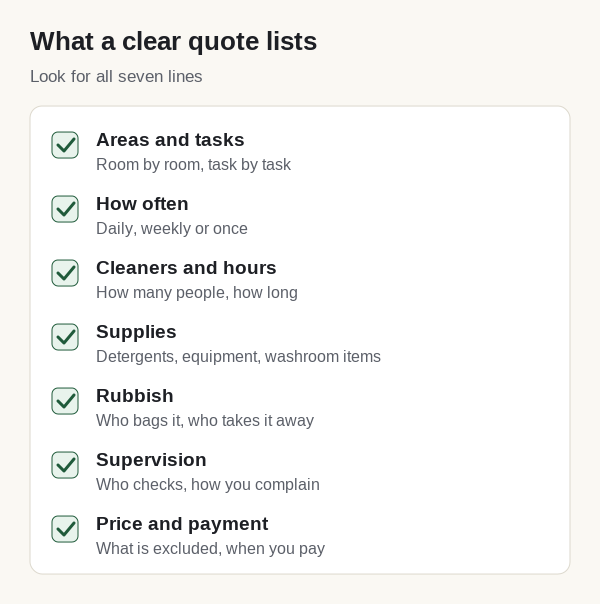
What should a clear quote from a cleaning company include?
A clear cleaning quote lists seven things: the areas to clean, how often, how many cleaners for how many hours, who supplies detergents and equipment, what happens to the rubbish, who supervises and how you complain, and how and when you pay.
If any of these is missing, you are not looking at a quote yet. You are looking at a guess.
Who is this guide for? Anyone hiring cleaners for a business space or a one-off job.
Think of an office manager looking for a monthly contract, or a landlord preparing a shop for a new tenant.
Or a family cleaning up after a wedding or a funeral gathering, or a company clearing the hall after its end-year party.
December is busy. Parties, weddings and office closures all land in the same few weeks, so good crews book up early.
Here is the whole process on one page. We go through each step below.
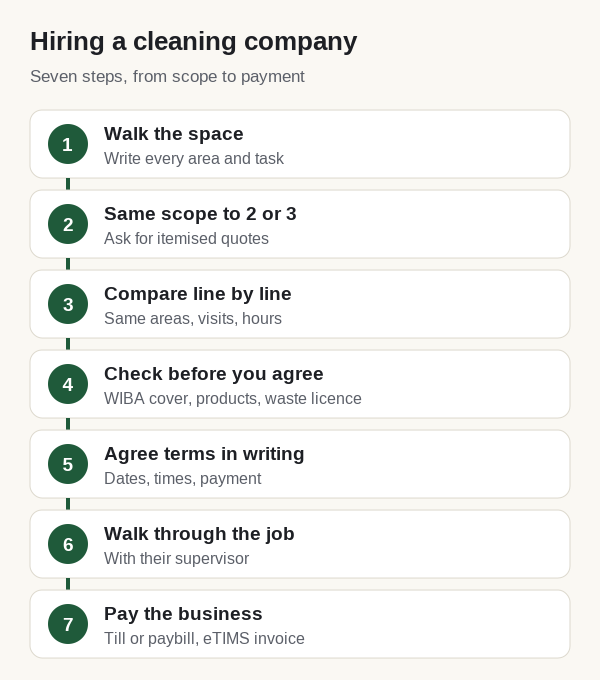
To hire a cleaning company without surprises:
- 1. Walk the space and write down every area and task
- 2. Send the same written scope to two or three companies
- 3. Compare itemised quotes line by line, with a site visit if the job is big
- 4. Check WIBA cover, the products they use and, for events, the waste plan[3][5][6]
- 5. Agree the dates, times and payment terms in writing
- 6. Walk through the finished job with their supervisor
- 7. Pay to a business till or paybill and get an eTIMS invoice[7]
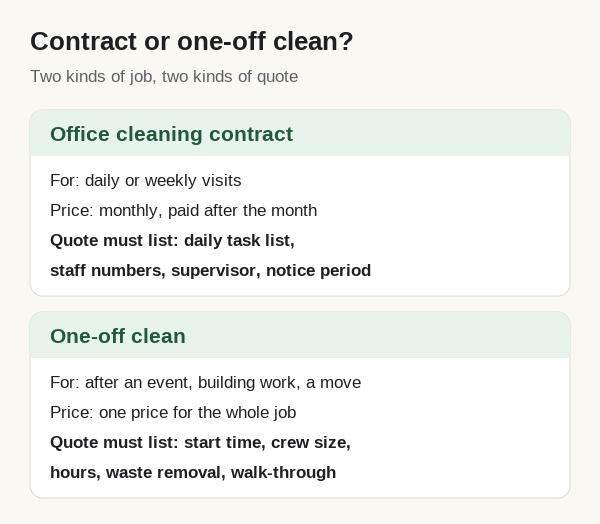
Do you need an office cleaning contract or a one-off clean?
It depends on whether the mess comes back every day or happens once.
An office cleaning contract covers regular visits: daily, a few days a week, or weekly. You agree a monthly price, a fixed list of tasks and a set number of cleaners.
A one-off clean is a single job with a clear end: after an event, after building or painting work, before you move in, or a deep clean before the new year.
For a contract, the details that matter most are the daily routine, who supervises, and how you end the contract if the standard drops.
For a one-off clean, the details that matter most are the start time, how long the crew needs, and where all the rubbish goes.
Not sure? Start with a one-off deep clean. You see how the company works before you sign anything long term.
What should the scope of work say?
The scope of work is your list of what gets cleaned, and how. Write it before you call anyone.
Walk the space with a notebook. Go room by room: reception, offices, meeting rooms, kitchen, washrooms, stairs, windows, outside areas.
Under each area, write the tasks. Sweep and mop floors. Empty bins. Wipe desks and door handles. Clean and restock washrooms. Wash cups in the kitchen.
Then add how often. Washrooms may need cleaning every day, while windows may need it once a month.
Say when the cleaners can work. Before 8am, after 5pm, or on Saturdays only. After-hours work can cost more, so ask.
For an event, add the size of the venue, the expected number of guests, and the time the venue must be handed back.
Note anything special: carpets, glass walls, a server room no one should enter, or floors that scratch easily.
A clear scope lets three companies price the same job. Without one, you get three quotes for three different jobs.
Who supplies detergents and equipment, and which products?
Decide this upfront. It changes the price a lot.
Some companies quote labour only: you buy the detergents, mops and tissue. Others quote all inclusive: they bring everything.
Washroom items need their own line. Tissue, hand soap, hand towels and sanitary bins can add up quickly in a busy office.
Ask which products they will use on your floors, glass and kitchen surfaces. A company that knows its work answers this easily.
For products made in Kenya, you can check the Kenya Bureau of Standards (KEBS) Standardization Mark yourself. SMS SM# followed by the permit number to 20023, or call KEBS toll-free on 1545[6].
If anyone in your office has allergies or asthma, say so. Ask for products without strong scents in shared spaces.
For big machines such as floor scrubbers or carpet extractors, ask whether they are included or charged per visit.
What happens to the rubbish after an event?
This is the question most people forget. After a wedding or an end-year party, there can be a mountain of bottles, plates, food waste and decorations.
Under the Sustainable Waste Management Act, 2022, a person who generates waste must separate it at source and hand it only to licensed waste service providers or designated collection points[2].
The same Act says public and private entities shall separate non-hazardous waste into organic and non-organic parts, placed in properly labelled, colour coded bins or bags[1].
So ask the cleaning company plainly: will you take the rubbish away, or only bag it?
If they take it away, ask for a copy of their licence to transport waste. The National Environment Management Authority (NEMA) says no person shall transport waste without a valid licence issued by NEMA[3].
NEMA also says a waste vehicle should be covered and labelled, and the transporter should carry a tracking note while moving the waste[3].
If they only bag it, ask the venue who collects it, and when. Do not leave it at the gate hoping someone picks it up.
Put food waste in one set of bags, and bottles, plastics and other dry rubbish in another. The Act asks for organic and non-organic waste to be kept apart, and it makes collection easier[1][2].
What should you ask about the cleaners, safety and insurance?
Cleaners will be in your space, sometimes after hours, around your equipment and files. It is fair to ask who they are and how they are covered.
Insurance for injuries. The Work Injury Benefits Act (WIBA), 2007 provides compensation to employees for work related injuries and diseases, according to the Directorate of Occupational Safety and Health Services (DOSHS)[4].
DOSHS says that when an accident happens, the employer is held responsible if it has not taken up WIBA insurance cover[5]. Ask the cleaning company for proof of current cover for its staff.
DOSHS also says an employer must report an accident to its county office within 24 hours if it is fatal, and within 7 days if it is not[5]. Ask how they would report an accident on your premises.
Identity and supervision. Ask whether cleaners wear uniforms and ID badges, and who their supervisor is. Get the supervisor's phone number.
Keys and access. Agree who holds keys, which rooms are off limits, and who signs in and out at the gate.
Safety at work. Wet floor signs, gloves and the right ladders for high windows should come with the crew, not as an afterthought.
Their answers tell you more than the price does:
- Can you show proof of current WIBA cover for your cleaners?[5]
- Who supervises, and how often do they check the work?
- What happens if a cleaner is absent? Who replaces them?
- Which products will you use here, and do they carry the KEBS mark?[6]
- Will you take the rubbish away, and do you hold a NEMA licence to transport waste?[3]
- How do I raise a complaint, and how fast will you fix it?
How do you compare cleaning quotes fairly?
Line them up against your scope, item by item. A cheaper quote often just leaves something out.
Check the basics first: the same areas, the same frequency, the same number of cleaners and the same hours.
Then check who supplies what. A labour only price looks cheap next to an all inclusive one, until you buy the detergents and tissue yourself.
For events, check whether waste removal is in the price or charged separately.
Watch the units. One company may quote per visit, another per month, another per square metre. Convert them all to the same thing before you compare.
Ask each company to visit the site for big jobs. A quote given over the phone for a large office is a rough guess, and the price can change on the day.
Finally, look at the extras: after-hours work, public holidays, carpet or window cleaning, and the cost of machines.
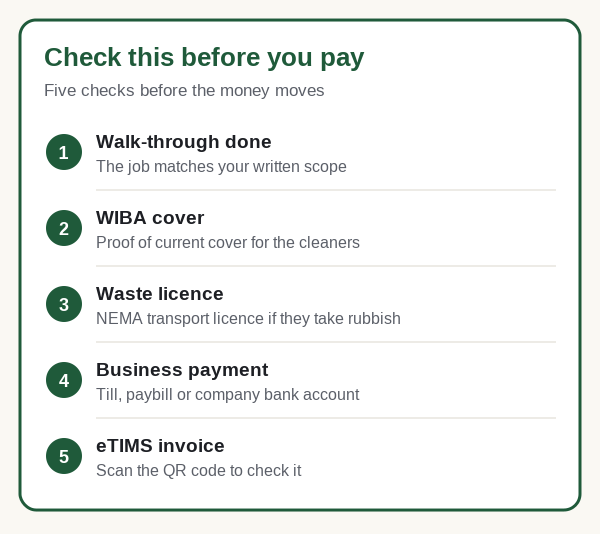
What must you have before you sign or pay?
Have these in hand before any money moves. If a company will not put one of them in writing, treat that as your answer.
Before you sign or pay:
- A written quote that matches your scope, area by area and task by task
- Dates, start and finish times, and the number of cleaners
- A clear line on detergents, equipment and washroom items: included or not
- For events, a written plan for the rubbish, and the NEMA transport licence if they carry it away[3]
- Proof of current WIBA cover for the cleaners[5]
- The supervisor's name and phone number
- For contracts, a notice period to end the contract
- The company's business name and a business till, paybill or bank account in that name
How should you pay, and what paperwork protects you?
Pay to a business till, paybill or bank account in the company's registered name, not a personal number you were sent on WhatsApp. Keep every M-Pesa message.
For a one-off clean, agree a small deposit to book the date if they ask for one, and the balance after you have walked through the finished job with the supervisor.
For a monthly contract, agree to pay at the end of each month, after the work is done, not months in advance.
Ask for an eTIMS invoice, one issued through the Kenya Revenue Authority (KRA) electronic Tax Invoice Management System. KRA says TIMS and eTIMS invoices carry a QR code you can verify with a QR reader[7].
You can also check it on the KRA invoice checker[7][8]. A real invoice protects you in a dispute and keeps your own business records clean.
What does a cleaning job cost, and how long does it take?
There is no official price list for cleaning in Kenya. Prices vary a lot, so the honest answer is: compare written quotes on the same scope.
These are the things that push the price up or down:
Size and layout. More floor space, more washrooms and more glass mean more hours.
Frequency. A daily contract costs more per month than a weekly one, but often less per visit.
Crew size and hours. Ask how many cleaners and for how long. This is the core of any quote.
Supplies. All inclusive quotes cost more on paper than labour only ones.
Timing. Night, weekend and public holiday work can cost more.
Waste removal. Carting away event rubbish is often a separate line.
Timelines: ask for quotes at least two weeks before an event in December, because crews book up. For an office contract, allow time for a site visit, quotes and a trial week before you sign for longer.
Tips from how cleaning jobs work in Kenya
A few habits make the whole job smoother.
Small things that save money and stress:
- Ask for a trial week before you sign a long contract
- Print the task list and stick it inside the cleaners' store, so everyone works to the same list
- For events, agree with the venue first what time cleaners can start and when the hall must be handed back
- Take photos before and after a one-off clean. They settle most disagreements in seconds
- Keep the supervisor's number and every message about the job in one chat
- Book December event cleaning when you book the caterer and tents, not the week before
Don'ts: what to avoid when hiring cleaners
Most problems come from a few habits. Avoid them every time.
Do not:
- Accept a one-line quote that says "office cleaning" and a price
- Pay the full amount upfront for a one-off job before the work is done
- Pay to a personal number when the company says it has a business
- Let anyone carry away event rubbish without asking where it is going[2][3]
- Hand over keys without agreeing who holds them and which rooms are off limits
- Sign a long contract with no notice period and no trial
Common mistakes, and what to do instead
Comparing prices, not scopes. The cheapest quote often leaves out washrooms, windows or supplies. Instead, compare every quote against your written scope.
Forgetting the rubbish. After an event, waste left at the gate becomes your problem. Instead, agree in writing who removes it, and check the licence if the company carries it away[3].
No walk-through. Paying before you look leads to arguments later. Instead, walk the space with the supervisor and pay once you are happy.
No complaint route. Without one, small problems pile up. Instead, agree who you call and how fast they fix things.
Skipping the insurance question. If a cleaner is hurt on your premises, you want the company to have WIBA cover in place[5]. Instead, ask for proof before work starts.
What can you do if the cleaning was not done properly?
Start with the supervisor. Send clear photos and the line from the scope that was missed, and give them a fair time to fix it.
Most good companies send a crew back quickly. That is why the walk-through and photos matter.
If they refuse and you have paid, put your complaint in writing and keep the quote, messages, photos and M-Pesa records together.
For a money dispute over a service contract, the Small Claims Court may help. The Judiciary says it handles claims about contracts for the sale and supply of goods or services, up to one million shillings[9].
The Judiciary also says the statutory lead time for cases filed there, the time the law sets for the court to finish a case, is 60 days[9].


