What should you agree before hiring a tailor or designer for a bulk order?
Agree six things in writing before any money moves: the brief, who buys the fabric, the approved sample, the fitting dates, the payment stages and the delivery date.
One page is enough. So is one clear WhatsApp message you can screenshot and keep.
Who is this guide for? Anyone ordering more than a handful of outfits made to order.
Think of a company kitting out its front desk or kitchen staff, or a bride dressing her whole bridal party.
Or a church choir, a chama ordering matching outfits for a big day, or a boutique asking a designer for a small run of a new style.
And the timing matters. December is wedding and party season in Kenya, and busy makers can book up as Christmas gets close.
Start now and you get calm fittings and time to fix mistakes. Start in mid-December and you take whatever slot is left.
Here is the whole order on one page. We walk through each step below.
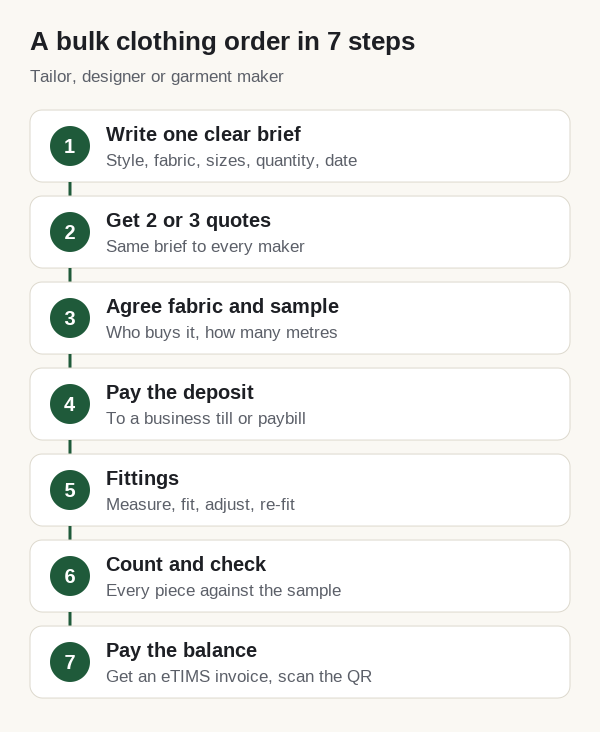
For a smooth bulk order:
- 1. Write one brief: style, fabric, colours, sizes, quantity per size, date[2]
- 2. Send the same brief to two or three makers and ask for an itemised quote
- 3. Agree who buys the fabric, how many metres each piece needs, and the purpose[3]
- 4. Approve a sample in the real fabric, label it and keep it[4]
- 5. Pay the deposit to a business till or paybill, against a written order
- 6. Hold the fittings on agreed dates, and confirm every change by message
- 7. Count and check the full delivery, then pay the balance and get an eTIMS invoice[5][6][9]
Do you need a tailor, a fashion designer or a garment factory?
It depends on one question: do you already know exactly what you want?
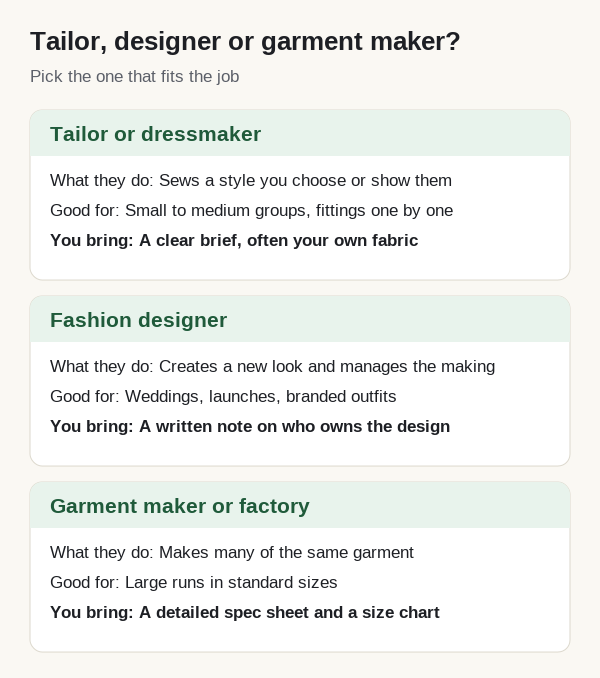
If you have a clear style, or a garment you can show, a tailor or dressmaker sews it for you. This suits small to medium groups that need each person fitted.
If you want a new look created, a fashion designer sketches it, suggests fabric and usually manages the making and fittings. This suits weddings, launches and branded outfits.
If you need many of the same garment in standard sizes, a garment maker or factory is built for that. They will want a detailed spec sheet and a size chart, and there is less room for one-by-one fittings.
What is a spec sheet? It is a short document, sometimes called a tech pack, that lists the measurements, fabric, trims, stitching and labels for each garment, so anyone can make it the same way.
Many good jobs mix these. A designer creates the look, then a tailor or small workshop sews the bulk.
When the maker supplies the materials and sells you the finished clothes, the Sale of Goods Act treats clothes made after you order them as future goods: goods to be manufactured or acquired by the seller after the contract is made[1].
That matters because the Act covers future goods, so the rules on description, fitness, samples and delivery below work for you[1].
If you bring the fabric and pay only for the sewing, the deal may count as a contract for work rather than a sale of goods. So put every term in writing either way.
What should a good brief for a bulk clothing order include?
A good brief lets three different makers price the same job. Without it, you get three quotes for three different outfits.
Put these in it: the style (photos or a sketch), the fabric type and colour, the trims (buttons, zips, lining), any logo or embroidery, the size list, the quantity per size, and the date you need everything.
Say what the clothes are for, too. "Kitchen staff in a hot kitchen" or "an outdoor wedding in Mombasa in December" tells a maker a lot about fabric.
This is not just good manners. Under section 16 of the Sale of Goods Act, if you make known the particular purpose and show you rely on the seller's skill or judgment, there is an implied condition that the goods shall be reasonably fit for that purpose[3].
That applies where the goods are a kind it is in the course of the seller's business to supply[3]. A tailor sewing work shirts clearly fits.
Your brief is also the description of the goods. Section 15 says that in a sale by description, the goods must correspond with the description[2].
And if you buy by sample as well as by description, the bulk must match both[2]. So keep the brief and the sample saying the same thing.
Who should buy the fabric, you or the maker?
Either can work. The mistake is not deciding, then arguing later about who was meant to do what.
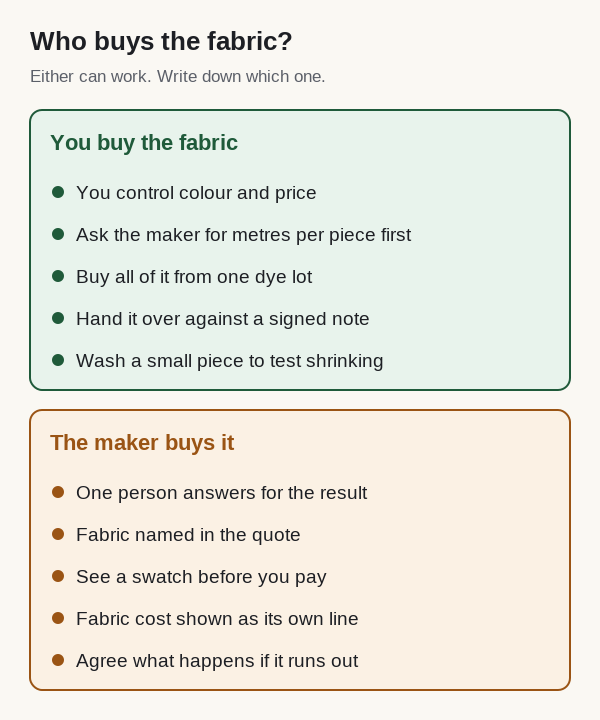
If you buy the fabric, you control the colour and price, but you also carry more of the risk if it is wrong for the job, because you chose it rather than relying on the maker's skill[3].
Ask the maker first how many metres each piece needs, plus a little extra for cutting.
Buy all of it at once, from one dye lot. A dye lot is one batch of dyed fabric, and two rolls of the "same" colour from different lots can look different side by side.
Hand it over against a short signed note: fabric, colour, metres and date. Ask for the leftover pieces back at the end.
If the maker buys the fabric, one person answers for the whole result. Ask for the fabric to be named in the quote, a swatch you can touch, and the fabric cost shown as its own line.
Agree in writing what happens if that fabric runs out half way. A "close enough" roll can spoil a matching bridal party.
Either way, wash or steam a small piece before cutting starts, to check for shrinking and colour running.
Why should you approve a sample before the bulk is made?
Because a sample turns "I thought it would look like..." into something both of you can hold.
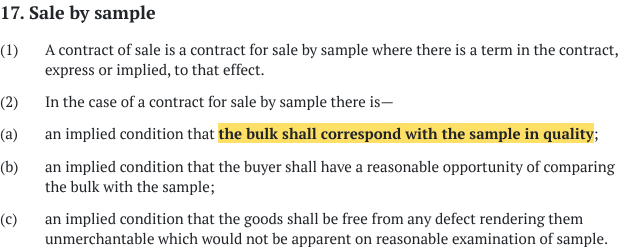
Under section 17 of the Sale of Goods Act, in a sale by sample there is an implied condition that the bulk shall correspond with the sample in quality[4].
You also get a reasonable opportunity to compare the bulk with the sample[4].
And the goods must be free from defects making them unmerchantable that would not be apparent on a reasonable examination of the sample[4].
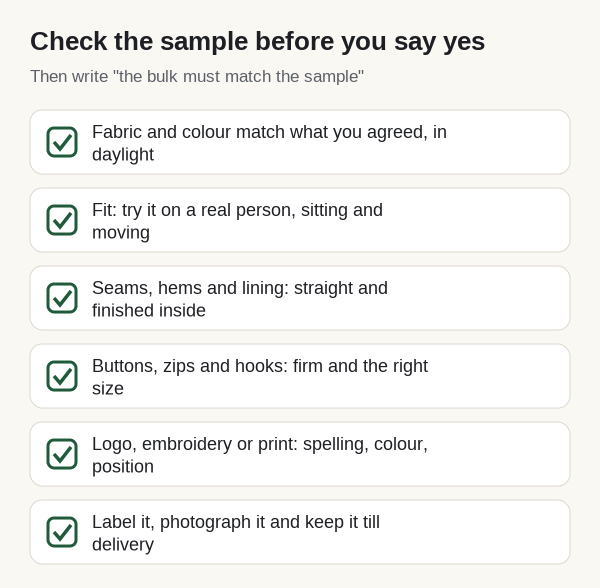
What makes it a sale by sample? A term in the contract, express or implied, that says so[4]. So write it plainly: "This order is a sale by sample. The bulk must match the approved sample."
Make the sample real: the actual fabric, the actual trims, the actual logo, in a common size. Try it on a real person, sitting down and moving about.
Then label it with the date and both your names, take clear photos, and keep it safe until delivery is checked.
A catalogue photo is not a sample. Neither is "like the one I made for another client".
How many fittings do you need, and how do you run them for a group?
For made-to-measure outfits, plan at least two touch points: a measuring day and a fitting. For fitted or formal wear, add a final fitting before collection.
Agree the dates when you order, not as you go. Put them in the same message as the price.
For a group, pick one measuring day and one place: the office, the church hall, or the bride's home. Chasing twenty people one by one is where weeks disappear.
Use the maker's own size chart, so everyone measures the same way. One maker's "medium" is rarely another's.
Keep one list: each person's name, phone number, measurements and the size of every item. One person holds that list and talks to the maker.
Someone always misses measuring day. Agree how they will be measured, and by when, before you start.
And every change after a fitting, however small, goes in writing with any new price or date. "We said on the phone" helps nobody in December.
Small habits that save the big day:
- Visit the workshop once mid-way. Ten minutes there tells you more than ten phone calls
- Ask for each person's outfit to be bagged and labelled by name
- Keep the quote, sample photos and every change in one WhatsApp chat
- For staff wear, order a few spares in the most common sizes for new joiners
- Book collection at least a week before the event, not the day before
Who owns a design you paid a fashion designer to create?
For the design drawings, usually you do under the Copyright Act, unless your agreement says otherwise[7]. Write it down anyway.
The Copyright Act counts drawings, and works of artistic craftsmanship, as artistic works[7].
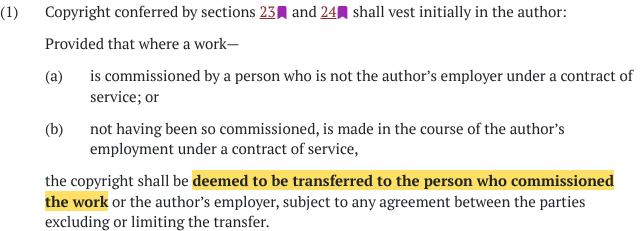
Section 31 says copyright vests first in the author. But where a work is commissioned by someone who is not the author's employer, the copyright is deemed to be transferred to the person who commissioned it[7].
That is subject to any agreement between the parties excluding or limiting the transfer[7]. A designer's terms may do exactly that, so read what you sign.
One honest caution. Copyright covers the creative work, such as the design drawings. Whether it stops someone else sewing a similar outfit is a harder legal question.
So if exclusivity matters to you, for a company look or a boutique's own style, put it in the agreement in plain words: "The design is ours. You will not make or sell it for anyone else."
Agree too whether the designer may post photos of your outfits on social media, and whether they must leave your logo off their own samples.
What must you have in hand before you pay a deposit?
Have every item on this list sorted before any money moves.
If a maker will not give you one of these, that is your answer. Thank them and move to the next quote.
Before you pay:
- A written brief with style, fabric, trims, sizes and quantity per size[2]
- An itemised quote: each garment, fabric, embroidery, delivery and alterations shown separately
- A written note on who buys the fabric and how many metres each piece needs
- An approved, labelled sample, and the words "sale by sample" in your order[4]
- Fitting dates, the delivery date, and what happens if a date is missed
- Deposit, middle payment and balance, and what each one is tied to
- Who owns the design, in writing, if it was created for you[7]
- The maker's business name, physical location and a business till or paybill
How should you structure deposits and payments?
Pay in stages, and tie each stage to something you have seen with your own eyes.
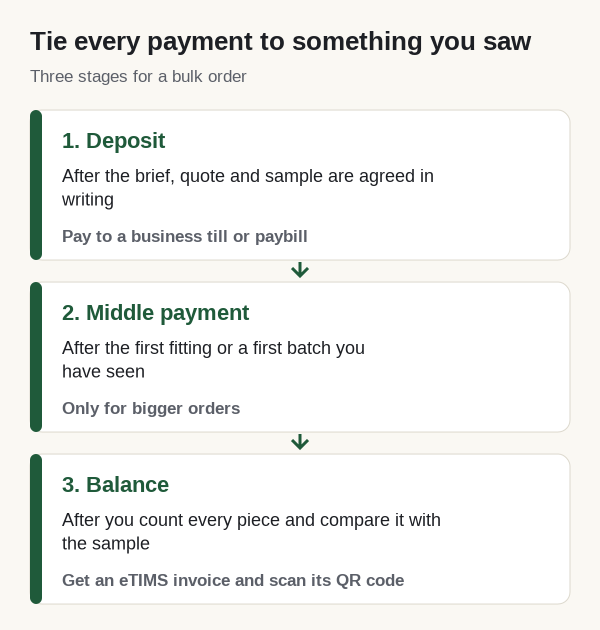
A fair pattern: a deposit once the brief, quote and sample are agreed, so the maker can buy fabric and start.
For a bigger order, add a middle payment after the first fitting or a first batch you have inspected. Then the balance after you have counted and checked everything.
Pay to a business till or paybill in the maker's business name, not a personal number sent on WhatsApp. Keep every M-Pesa message.
Paying now and collecting later, say outfits for your own wedding party? The Consumer Protection Act, 2012 calls this a future performance agreement: delivery, performance or full payment is not made when you agree the deal[8].
Section 18 says every such agreement shall be in writing and delivered to the consumer[8]. Section 19 lets the consumer cancel within one year if they did not get a proper copy[8].
And under section 21, if delivery is more than thirty days after the date in the agreement (or a new date agreed in writing), the consumer may cancel before delivery[8].
If you then agree to accept the late delivery, you lose that right to cancel[8].
These sections apply where the total payment is above an amount set by regulations[8]. Whatever the amount, leave with a written order.
Buying for a company, church or organisation? Ask for an eTIMS invoice, the electronic tax invoice registered with the Kenya Revenue Authority (KRA).
KRA says that to claim a business expense, it must be supported by an electronic tax invoice, and that all persons engaged in business are required to issue them[9].
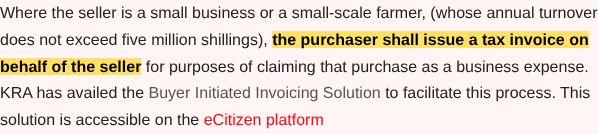
If the maker is a small business with annual turnover of five million shillings or less, KRA says the buyer issues the invoice on the maker's behalf to claim the purchase as a business expense, using the Buyer Initiated Invoicing solution on eCitizen[9].
Then check the invoice. KRA says TIMS and eTIMS invoices carry a QR code you can verify with a QR reader, and there is an invoice checker on iTax[10].
What should you check when the outfits are delivered?
Count and inspect before you sign anything or pay the balance. The law backs you on this.
Section 35 of the Sale of Goods Act says that where goods are delivered which you have not examined, you are not deemed to have accepted them until you have had a reasonable opportunity to examine them[6].
The seller must, on request, give you that opportunity, unless you agreed otherwise[6].
So open every bag. Count each item by size against your list, and compare pieces from every size with the labelled sample.
Check logos and embroidery on several pieces, not just the top one. Try on a few outfits from the big and small ends of the size list.
If fewer pieces arrive than you ordered, section 31 says you may reject them. If you accept them, you pay for them at the contract rate[5].
If some pieces are a different item or fabric from what you ordered, you may accept the ones that match and reject the rest, or reject the whole lot, unless your agreement, trade custom or past dealings say otherwise[5].
Found a problem? Photograph it, list it and send it to the maker the same day. Agree the fix in writing: what gets redone, by when, and who pays transport.
How much does a bulk tailoring order cost, and how long does it take?
Honestly, prices vary too much by fabric, style, embroidery and quantity for one fair figure. So make the quotes comparable instead.
Ask every maker to price the same brief, garment by garment, with fabric, embroidery or printing, delivery and alterations as separate lines.
Then work out the price per complete outfit and multiply by your numbers. Watch for one quote that is cheap only because it leaves out the fabric or the logo.
A cheaper outfit in thin fabric that fades after a few washes costs you more by the second term or the second event.
Time is the cost most buyers forget. Count backwards from your date: collection, final fitting, sewing the bulk, first fitting, sample approval, fabric buying, and quotes.
For a December event, this is the month to start. Makers can get busy with weddings, parties and school wear as the year ends.
The checks in this guide cost almost nothing. Checking an eTIMS QR code takes a minute with any QR reader, and the KRA invoice checker is on iTax[10].
And if a dispute ever reaches the Small Claims Court, the Act says the matter shall be heard and determined within sixty days from the date of filing[11].
What should you never do when ordering clothes in bulk?
These habits put your money and your date at risk. Avoid them every time, even with a maker you know well.
Do not:
- Pay the full amount upfront for outfits you have not seen
- Accept a catalogue photo or another client's outfit as your sample[4]
- Hand over fabric without a note of the metres and colour
- Agree changes on a call without confirming them by message
- Pay to a personal number when the maker says they have a business
- Sign for a delivery before you count it[6]
- Assume you own a design without saying so in writing[7]
What are the most common mistakes buyers make?
Choosing on price alone. The lowest quote can hide thinner fabric, no embroidery or a late date. Compare the same brief line by line, and look at the sample.
A vague brief. "Nice African print shirts for 30 staff" can be priced a hundred ways. Give the style, fabric, sizes and quantity per size[2].
Not saying what the clothes are for. Tell the maker about the heat, the work or the event, so you can rely on their skill[3].
Fabric from two dye lots. Buy it all at once, or ask the maker to confirm one lot in writing.
No group size list. One shared list, one person in charge, one measuring day.
Collecting the day before. Leave at least a week to fix hems, swap sizes and redo a logo.
What can you do if the order goes wrong?
Start in writing, and stay calm. Send the maker a short message with the problem, the term you agreed (the brief, the sample, the quantity, the date) and your photos.
Say what you want: a redo, a refund or a price cut, and give a clear deadline. Written terms make this conversation much easier.
If that fails, the Small Claims Court can hear civil claims relating to a contract for the sale and supply of goods or services[11].
The Act limits the court to claims of up to one million shillings, unless the Chief Justice sets a different limit by Gazette notice[11], and says a matter shall be heard and determined within sixty days from filing[11].
Bring your brief, quote, sample photos, fabric hand-over note, M-Pesa messages and invoice. That paper trail is your case.
Still looking for a maker? Biashara Pros lists fashion designers, tailors and clothing makers you can compare before you call. Only those marked Verified have passed a current registration or KRA PIN check.
Whoever you choose, use the steps in this guide. They work with any maker.