What should you agree before ordering school uniforms for January?
Agree seven things in writing before you pay a shilling: the sample, the size list, the quantity per size, the unit price, the deposit and balance, the delivery date, and what happens if pieces come out wrong.
It does not need to be fancy. One page, or one clear WhatsApp message you can screenshot, is enough.
Without it, every January problem turns into your word against the maker's. With it, most problems get sorted in one message.
Who is this for? Anyone buying more than one or two sets.
Think of a parents' group pooling an order, or a school, church or bursary programme buying for learners it supports.
Or a private school sorting sports kits, or a family with three children starting new schools at once.
And yes, the rush is real. Schools usually reopen in early January, and children have shot up over the long holiday.
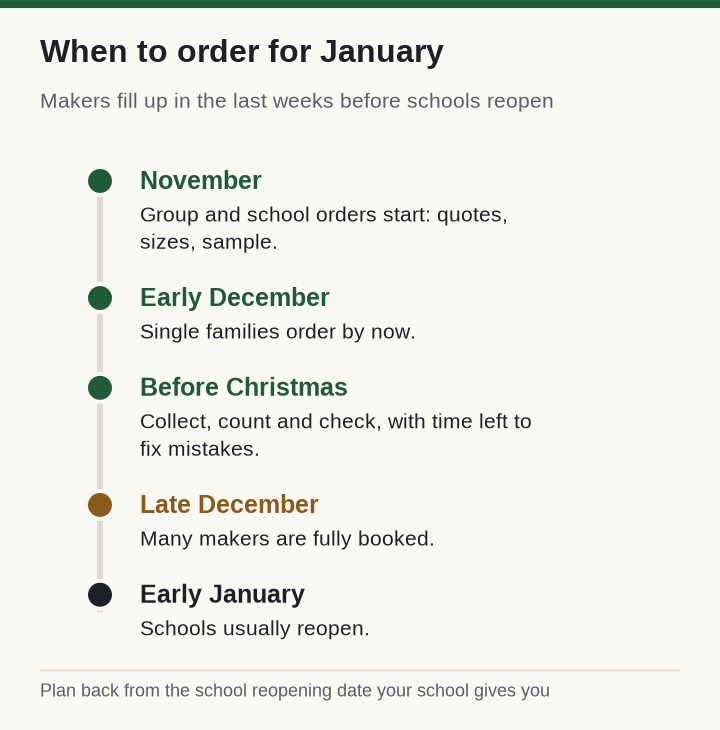
Many busy uniform makers stop taking new work before Christmas. Order in November and your uniforms get measured, sewn and checked calmly. Order on 2 January and you get whatever is left.
Here is the whole order on one page. We go through each step below.
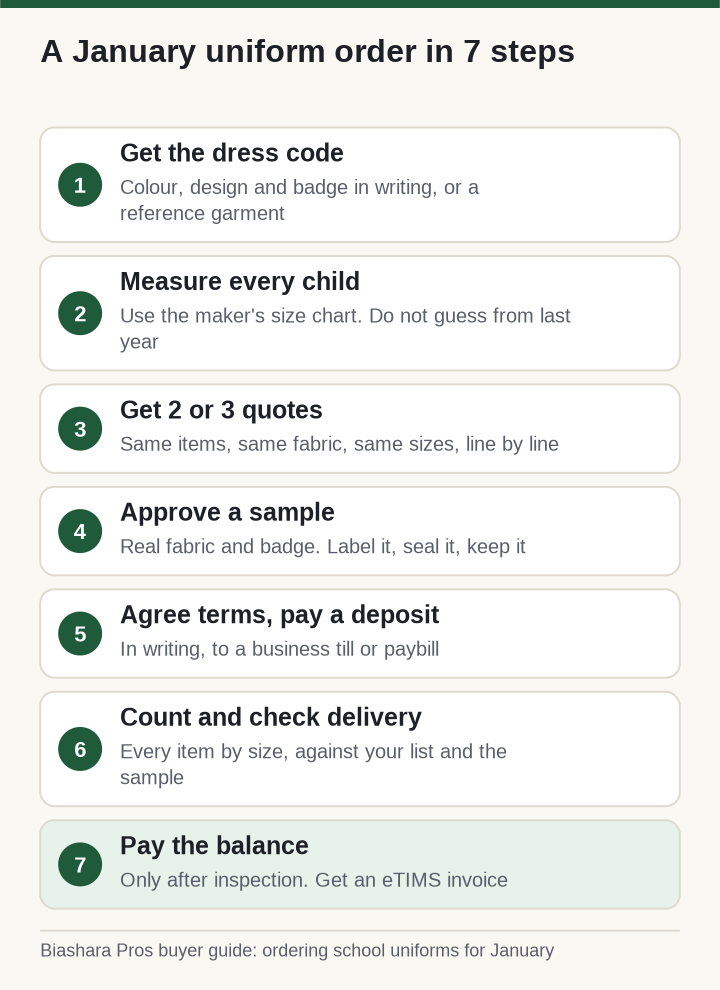
For a smooth January order:
- 1. Get the school's dress code or a reference garment in writing[1]
- 2. Collect sizes: measure each child, do not guess from last year
- 3. Ask two or three makers to quote the same list, item by item
- 4. Choose one, approve a sample and keep it sealed and labelled[3]
- 5. Sign or message the order terms, then pay the deposit to a business till or paybill
- 6. Check a first batch mid-way, then count and inspect the full delivery[4][5]
- 7. Pay the balance only after inspection, and get an eTIMS invoice[7][8]
Can a school tell parents where to buy uniforms?
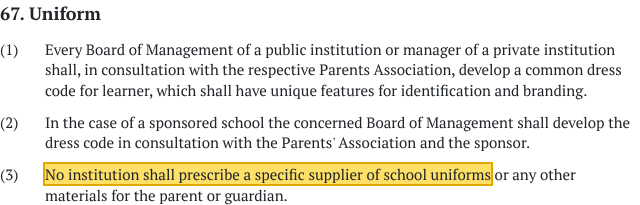
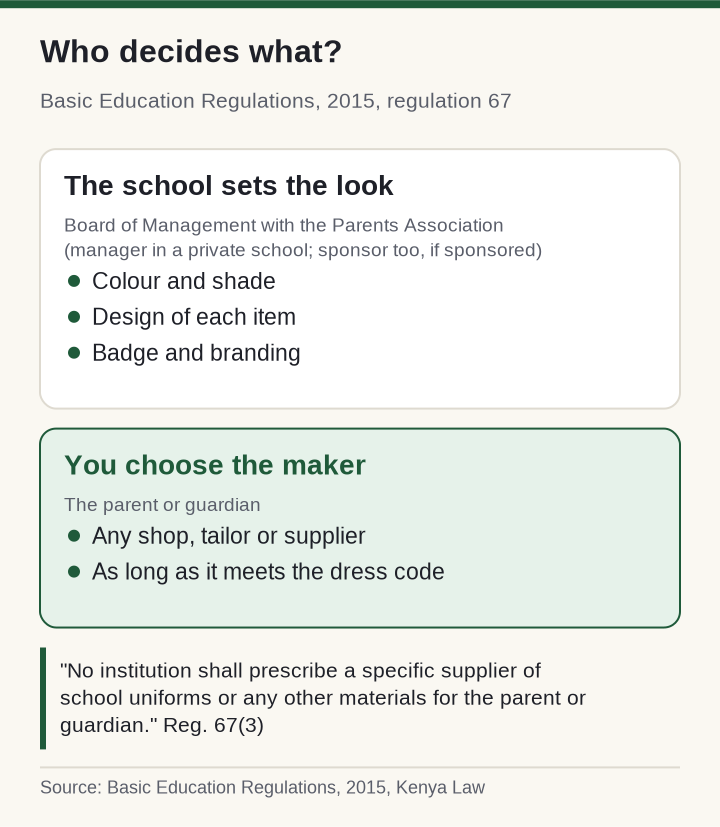
No, it cannot. Regulation 67(3) of the Basic Education Regulations, 2015 says no institution shall prescribe a specific supplier of school uniforms or any other materials for the parent or guardian[1].
Put simply: the school sets the look, and you choose the shop.
Who sets the look? In a public school, the Board of Management develops a common dress code together with the Parents Association. In a private school, the manager does[1].
The dress code can carry unique features for identification and branding, and in a sponsored school the sponsor is consulted too[1].
So the school may decide the colour, the design and the badge. It may not decide who sews it.
The Ministry has said the same thing out loud. In October 2023 the then Education Cabinet Secretary, Ezekiel Machogu, spoke to MPs about it (Education News report)[2].
He said a circular sent to regional and county directors of education in May 2023 banned schools from selling uniforms or prescribing sellers[2].
In his words, as reported, it is up to the parent to buy from wherever, as long as the uniform meets the school's requirements[2].
One honest warning, though. The real risk of buying outside is not the law. It is a sweater in the wrong shade that gets sent back at the school gate.
So before you shop, get the exact requirement: colour and shade, fabric type, the design of each item and the badge. A reference garment you can show the maker is even better.
One more thing to watch. In May 2026, the National Conference on Education in Naivasha recommended standardised school uniforms across all levels, with each school keeping its own badge[11].
Some news sites reported this as a Ministry policy (Teachers Arena report)[11]. At the same conference, President Ruto raised concern over the rising cost of school uniforms (The Star report)[10].
These were resolutions and statements reported in the news. When we checked, we could not find a Ministry rule giving a new design or start date.
Until the Ministry publishes a rule, play it safe. Before a big order:
- Ask the school in writing whether its uniform will change for the 2027 school year
- Order for one year's need, not three, while the policy is unclear
- Keep badges as a separate line in the quote, so a design change costs less
Why should you order against a sample?
Because then the law works for you, not against you.
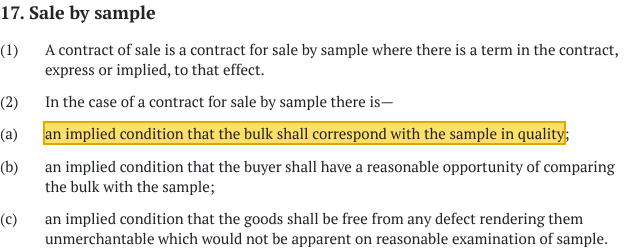
Under section 17 of the Sale of Goods Act (Cap. 31), in a sale by sample there is an implied condition that the bulk shall correspond with the sample in quality[3].
You also get a reasonable opportunity to compare the bulk with the sample[3].
And the goods must be free from any defect making them unmerchantable that would not be apparent on a reasonable examination of the sample[3].
What is a sale by sample? It simply means the contract has a term, express or implied, that you are buying goods like a sample you were shown[3].
So say it plainly in your order message: "This order is a sale by sample. The bulk must match the approved sample."
Then make the sample real. Approve one full set in the actual fabric, in a common size, with the same badge or embroidery the bulk will carry.
Label it with the date and both your names, take clear photos, and keep it safe until the order is delivered and checked.
A photo from the maker's catalogue is not your sample. Neither is "the same as last year".
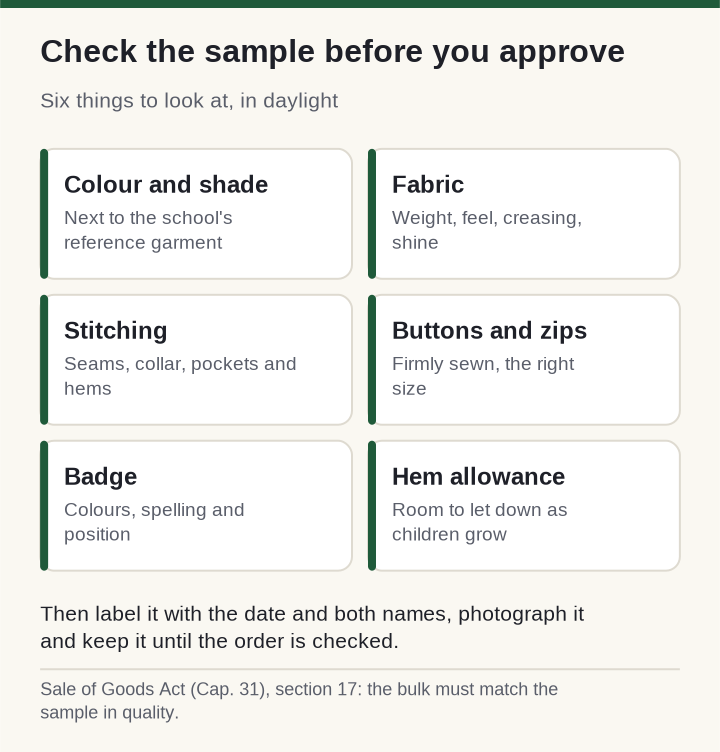
Before you approve it, look at:
- Colour and shade next to the school's reference garment, in daylight
- Fabric weight and feel, and whether it creases or shines
- Stitching at the seams, collar, pockets and hems
- Buttons, zips and press studs: firmly sewn and the right size
- Badge or embroidery: colours, spelling and position
- Hem allowance: enough to let trousers or skirts down as children grow
How do you get sizes and quantities right?
Measure, then add a little margin. A lot of January uniform trouble is size trouble, and it usually starts with guessing.
Ask the maker for their own size chart first, so everyone measures the same way. One maker's "size 10" is rarely another's.
For a group order, keep one simple list: the child's name, age, height, chest or waist, and the size of each item.
Last year's sweater label tells you very little about this year's shirt. Measure the child, not the old uniform.
Next, agree in writing how many pieces of each item you want in each size. "200 shirts" is not an order. "40 shirts in size 8, 60 in size 10..." is.
Then agree what happens to spares. A few extra pieces in the most common sizes will save you when a child grows again or a new learner joins in January.
The law cares about quantities too. Under section 31 of the Sale of Goods Act, if a maker delivers fewer pieces than you contracted for, you may reject them. If you accept them, you pay at the contract rate[4].
If they deliver more than you ordered, you may accept the agreed quantity and reject the rest, or reject the whole lot[4].
A clear quantity list is what makes these rules usable when you need them.
What must you have in hand before you pay a deposit?
Have everything on this list sorted before any money moves.
If a maker will not give you one of these, that is your answer. Thank them and move to the next quote.
Before you pay:
- The school's dress code or a reference garment
- A written quote listing every item, size range, quantity and unit price
- An approved, labelled sample, and the words "sale by sample" in your order[3]
- Deposit amount, balance and when each is paid
- A firm delivery or collection date, and what happens if it is missed
- A written rule for wrong sizes, faults and missing pieces
- The maker's business name, physical location and a business till or paybill
- For parents paying now and collecting later: a written order slip you keep[6]
How should deposits and payments work?
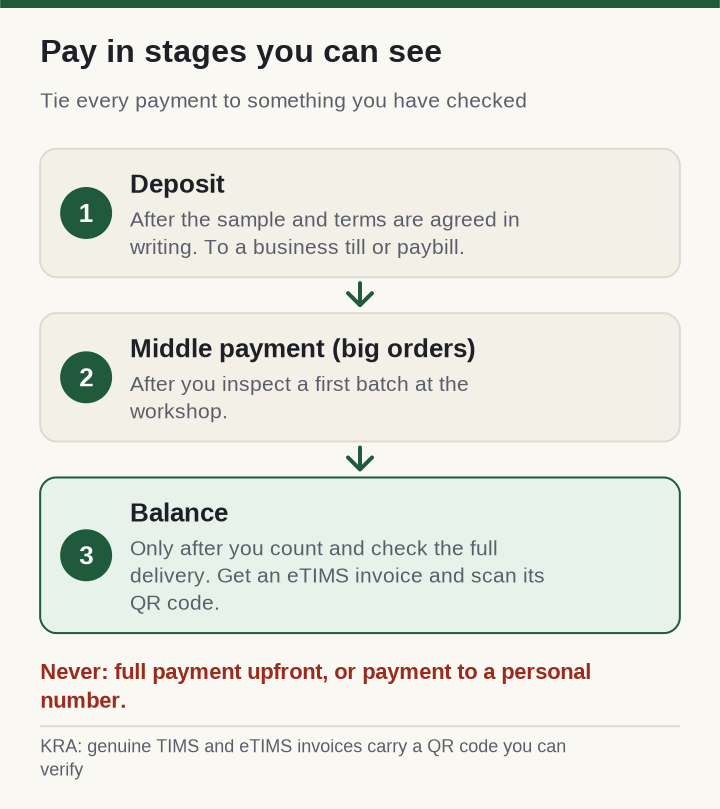
Pay in stages, and tie each stage to something you can see with your own eyes.
A common, fair pattern: a deposit to confirm the order and buy fabric, then the balance after you have counted and checked the delivery.
For a big order, add a middle stage after you inspect a first batch. It keeps both sides honest.
Now, a word for parents paying now and collecting later. The Consumer Protection Act, 2012 calls this a future performance agreement: delivery, performance or full payment is not made when the deal is struck[6].
Section 18 says every such agreement shall be in writing, delivered to the consumer and made in line with the prescribed requirements[6].
Section 19 lets a consumer cancel it within one year if they did not receive a proper copy[6].
Section 17 says these rules apply where the consumer's total payment is above an amount set by regulations[6]. Whatever the amount, always leave with an order slip.
Pay to a business till or paybill in the maker's business name, not a personal number sent on WhatsApp. Keep every M-Pesa message.
Then ask for an eTIMS invoice, the electronic tax invoice registered with the Kenya Revenue Authority (KRA).
KRA says all persons engaged in business are required to issue electronic tax invoices, and that schools supplying education services must also be on eTIMS[7].
Buying for a school or organisation? The law requires a business expense to be supported by an electronic tax invoice before you can claim it[7].
Is the maker a small business with annual turnover of five million shillings or less? Then KRA says the buyer issues the invoice on the seller's behalf[7].
You do this with KRA's Buyer Initiated Invoicing solution on eCitizen, if you want to claim the purchase as an expense[7].
Either way, check the invoice. KRA says genuine TIMS and eTIMS invoices carry a QR code you can verify with a QR reader, and there is an invoice checker on iTax too[8].
What should you check when the uniforms arrive?
Count and inspect before you sign anything or pay the balance. The law gives you that right.
Section 35 of the Sale of Goods Act says that where goods are delivered which you have not examined, you are not deemed to have accepted them until you have had a reasonable opportunity to examine them[5].
The seller must, on request, give you that opportunity[5]. So ask for it, politely and firmly.
Then use it well. Open the bales or bags and count each item by size against your list.
Compare a few pieces from every size with the sealed sample. Check the badge spelling on several pieces, not just one.
Found a problem? Write it down, take photos and send the list to the maker the same day, while it is fresh.
What if some pieces are a different item, size or fabric from what you ordered? Section 31 says that where goods you ordered arrive mixed with goods of a different description, you may accept those that match and reject the rest, or reject the whole[4].
That holds unless your agreement says otherwise. Agree the fix in writing: replacement pieces, a date, and who pays for transport.
Small habits that save January:
- Put one person in charge of a group order, with one shared list and one M-Pesa record
- Visit the workshop once mid-way. You learn more in ten minutes there than in ten phone calls
- Ask the maker to bag and label each child's set by name for group orders
- Wash one piece before the bulk is finished to check for shrinking and colour running
- Save the maker's quote, your sample photos and every message in one WhatsApp chat or folder
How much does it cost, and how long does it take?
Honestly, prices vary too much by fabric, item, size and badge work for one fair figure. So compare like with like.
Ask every maker to price the same items, in the same fabric and the same sizes. Ask them to show the badge, delivery and any alteration charges as separate lines.
Then work out the price per complete set, say shirt, trousers or skirt, sweater and tie, and multiply by your numbers.
A cheaper set in thin fabric that needs replacing by second term ends up costing you more over the year.
Time is the cost most buyers forget. You need room for quotes, sample approval, any changes, sewing, a mid-way check, delivery and fixes.
For a group or school order, start in November. For one family, order by early December. Many makers are fully booked in the last weeks before schools reopen.
The checks in this guide cost you almost nothing. Scanning an eTIMS QR code is free with any QR reader, and the KRA invoice checker is online[8].
And if a dispute ever reaches the Small Claims Court, the Act says the case shall be heard and determined within sixty days from the date of filing[9].
What should you avoid when ordering school uniforms?
A handful of habits cause most of the losses we hear about.
Avoid them every single time, even with a maker you have known for years.
Do not:
- Pay the full amount upfront for an order you have not seen
- Accept a catalogue photo as your sample[3]
- Order every size from last year's list without measuring
- Pay to a personal number when the maker says they have a business
- Sign for a delivery before you count it[5]
- Order three years of uniforms while the 2027 policy is unclear[11]
- Leave a parent without a written order slip[6]
What are the most common uniform ordering mistakes?
Choosing on price alone. The lowest quote often hides thinner fabric, no badge or a late date. Compare the same items line by line, and look at the sample.
Approving a sample in the wrong fabric. Approve one sewn in the exact fabric and colour the bulk will use, and keep it sealed[3].
No quantity per size. List how many of each size, item by item[4].
Verbal changes. A change agreed on a quick call is easy to forget. Confirm every change by message, with the new price and date.
Forgetting the badge. Badges and embroidery often take longest. Confirm the badge design, and who supplies it, at the very start.
Collecting late in a hurry. Book a collection date before Christmas, with time left to fix mistakes.
What can you do if the order goes wrong?
Start in writing, and stay calm. Send the maker a short message with the problem, the term you agreed (the sample, the quantity, the date) and your photos.
Say what you want: replacement, refund or a price cut. Give a clear deadline. Many problems end right there when the terms were written down.
If that fails, the Small Claims Court can hear civil claims about a contract for the sale and supply of goods or services[9].
The Act sets its limit at one million shillings, or such other sum as the Chief Justice may set by notice in the Gazette[9].
It also says a case shall be heard and determined within sixty days from the date of filing[9].
Bring your quote, sample photos, M-Pesa messages and the eTIMS invoice. That paper trail is your whole case.
Still looking for a maker? Biashara Pros lists uniform makers and clothing suppliers you can compare before you call. Only those marked Verified have passed a current registration or KRA PIN check.
Whoever you choose, use the steps in this guide. They work with any maker.