How do you order branded calendars and gifts without problems?
Send every printer the same written brief, compare itemised quotes, approve a written proof and then a physical sample, and fix a delivery date before you pay a deposit. Then check the delivery against the sample before you pay the balance.
That sounds like a lot of steps for a box of diaries. But end-year printing goes wrong in the same few ways every year.
A misspelt name. A logo in the wrong green. A holiday on the wrong day. Mugs that arrive on 23 December, after the office has closed.
Every one of those is cheap to catch at the proof stage and expensive to fix after the print run.
End-year is a busy time for printers, and everyone wants delivery "before the party".
So the earlier you send a clear brief, the more choice you have and the more time you keep for checking.
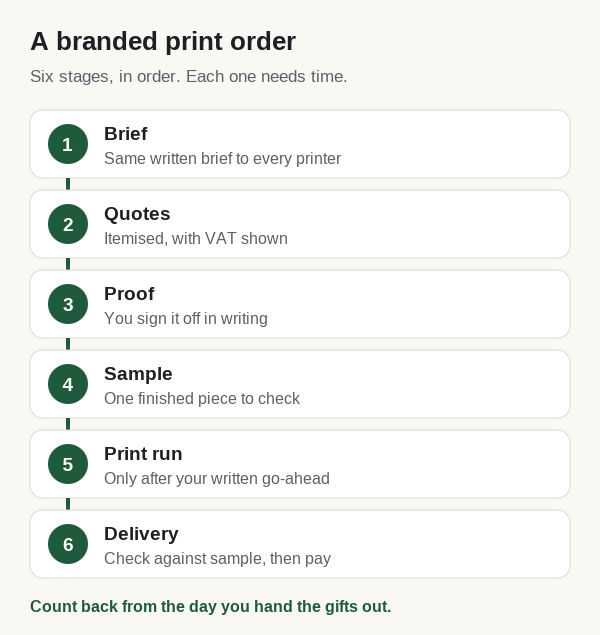
For any branded print order:
- 1. Fix the date you will hand the items out, then count back
- 2. Write one brief and send it to two or three printers
- 3. Compare itemised quotes, all with VAT included[4]
- 4. Approve a written proof, line by line
- 5. Approve one finished sample before the full run
- 6. Pay a deposit to a business till or paybill, with the delivery date in writing
- 7. Check the delivery against the sample, then pay the balance and get an eTIMS invoice[6]
What should your printing brief include?
A good brief gets you quotes you can actually compare. A vague one gets you three prices for three different products.
The item, exactly. "Desk calendar" is not enough. Say wall or desk, number of pages, size, paper type if you know it, and binding (wire, stapled, glued).
The quantity. Give the exact number, and ask for prices at two quantities, for example 200 and 300. The price per piece usually falls as the quantity rises, so this shows you where the break is.
Colours and branding. Say how many colours your logo uses and send the official colour codes if you have them. For gifts, say where the logo goes and how big.
The finish. Lamination, embossing, foil, gift boxes, wrapping. Each one adds cost and time, so list what you want and ask for it priced line by line.
Artwork. Say whether you will send ready artwork or need the printer to design it. Design is a separate cost.
Delivery. Address, date and whether the printer delivers or you collect. If items go to several branches or towns, list them.
Write the brief once and paste the same text to every printer. Keep it in one chat or email thread. When quotes come back, you can check each one against the same list, and if anything goes wrong later you have the brief in writing.
What is a print proof, and what should you check on it?
A proof is the printer's final layout of your job, sent for you to approve before printing starts. It is usually a PDF. For bigger jobs, ask for a printed proof as well, because colours on a phone screen are not the colours on paper.
Approving the proof tells the printer to print exactly what you see. Before you approve, ask in writing who pays for a reprint if a mistake on the approved proof is found later.
Then read it slowly, and get a second person to read it too.
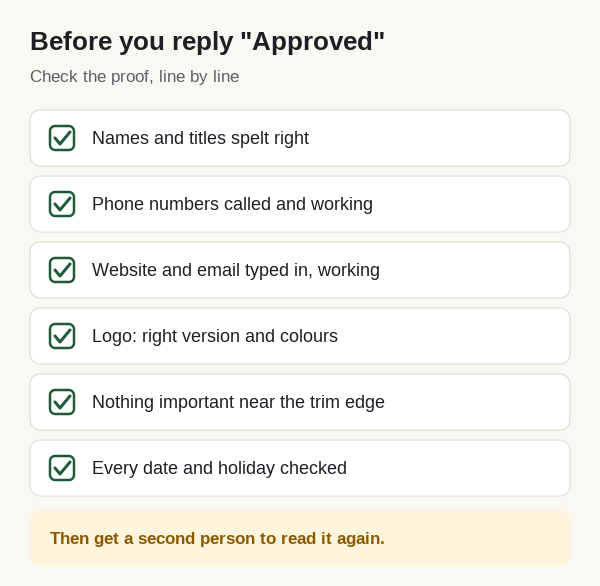
Check names and titles letter by letter, especially for personalised diaries and certificates. Check every phone number by calling it. Check the website and email address by typing them in.
Check the logo: right version, right colours, not stretched or blurry. Check that nothing important sits too close to the edge, where it may be trimmed off.
Then reply in writing: "Approved" or a numbered list of changes. Never approve on a call.
Which public holidays must a 2027 calendar show?
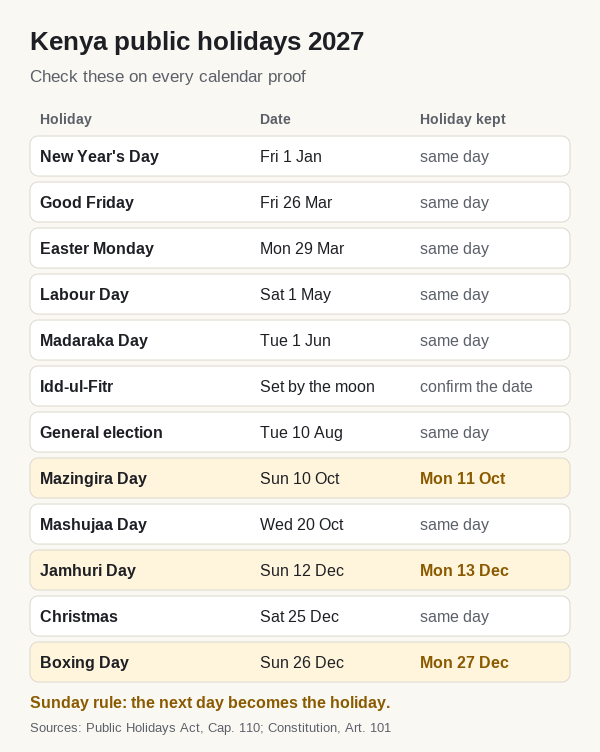
Kenya's Public Holidays Act lists 11 public holidays kept every year: New Year's Day, Good Friday, Easter Monday, Labour Day, Madaraka Day, Idd-ul-Fitr, Mazingira Day, Mashujaa Day, Jamhuri Day, Christmas and Boxing Day[2].
The fixed dates are 1 January, 1 May, 1 June, 10 October, 20 October, 12 December, 25 December and 26 December[2]. Good Friday and Easter Monday fall in March or April. Idd-ul-Fitr depends on the appearance of the moon[2].
Watch the name: the Act now lists Mazingira Day on 10 October[2]. An old calendar template may still carry a different name for that day, so check it.
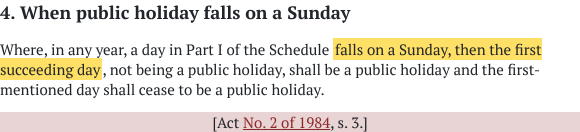
The Sunday rule. When a holiday in that list falls on a Sunday, the next day that is not already a holiday becomes the public holiday instead[2].
This matters for 2027. Mazingira Day (10 October), Jamhuri Day (12 December) and Boxing Day (26 December) all fall on a Sunday in 2027. So the public holidays are Monday 11 October, Monday 13 December and Monday 27 December.
Christmas 2027 falls on a Saturday, so it stays on 25 December. Easter Sunday falls on 28 March in 2027, which puts Good Friday on 26 March and Easter Monday on 29 March.
Two more holidays in the Act apply to particular faiths: Idd-ul-Azha for people of the Islamic faith and Diwali for people of the Hindu faith[2]. Ask the printer whether your template shows them.
2027 is also a general election year. The Act provides for general election day to be a public holiday[2], and the Constitution sets the election for the second Tuesday in August[9], which is Tuesday 10 August 2027. Watch for the government's notice in the Kenya Gazette confirming it nearer the time.
The day a new President is sworn in is a holiday too[2], but that date is not known yet, so leave it to be confirmed.
Moon-dependent days are confirmed nearer the time, and the Cabinet Secretary can declare an extra holiday or move one by notice in the Kenya Gazette[2]. So mark Idd-ul-Fitr as "date to be confirmed" or ask the printer which date they have used, and say so in your brief.
Before you approve:
- All 11 yearly holidays in the Act are marked, with Mazingira Day on 10 October[2], plus general election day, Tuesday 10 August 2027[2][9]
- Monday 11 October, Monday 13 December and Monday 27 December shown as holidays (Sunday rule)[2]
- Good Friday 26 March and Easter Monday 29 March
- Idd-ul-Fitr marked as set by the moon, or the date the printer used noted in writing[2]
- 1 January 2027 falls on a Friday, so the first week starts on the right day
Why should you approve a physical sample before the full run?
A proof shows the layout. A sample shows the real thing: the paper, the binding, the true colours, how the logo sits on a curved mug or a cloth bag.
For gifts, the sample tells you more than any picture. Does the pen write? Does the print on the mug survive a wash? Is the notebook cover as stiff as you expected?
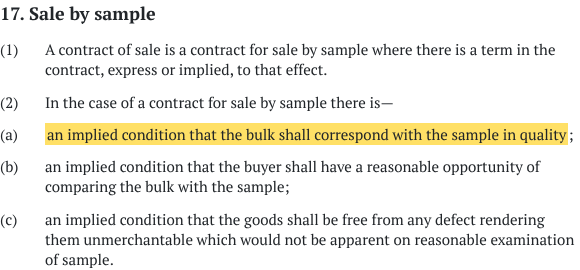
There is a legal reason too. For goods bought by sample, Kenya's Sale of Goods Act says there is an implied condition that the bulk shall correspond with the sample in quality[3].
It also gives you the right to a reasonable opportunity to compare the bulk with the sample[3]. These conditions apply when the contract is a sale by sample, meaning it has a term to that effect[3].
So label the sample, keep it, and write on the order: "Bulk to match approved sample dated ...". When the delivery comes, open a few boxes and compare before you sign.
Who owns the design you paid for?
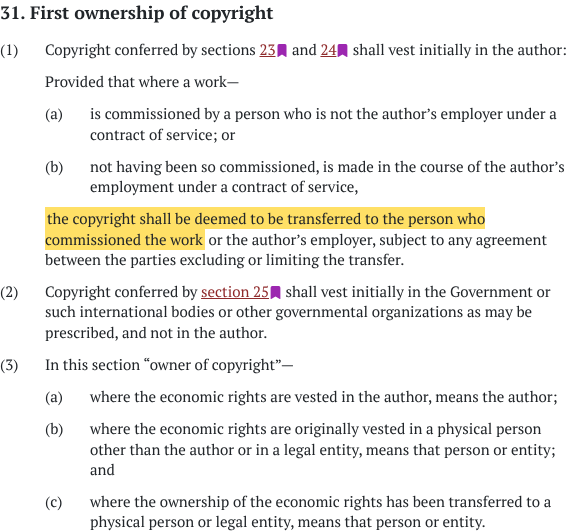
Usually you do, if a designer made it for you and you have not agreed otherwise. This covers the work made for you, not stock templates, fonts or photos the printer licenses from others. The Copyright Act says that where a work is commissioned by someone who is not the author's employer, the copyright is deemed to be transferred to the person who commissioned it[1].
The catch is the last part of that section: "subject to any agreement between the parties excluding or limiting the transfer"[1]. A printer's terms, a quote or an order form can change who owns the design. Read them.
Ownership on paper is not much use without the files. Ask, in writing, for the editable source files and a high-resolution version of the final design when you pay. Then next year's calendar does not start from zero, and you can take the job to another printer.
If you send your own artwork, only send logos, photos and fonts you have the right to use. A photo copied from the internet can belong to someone else.
Write: "Design and artwork made for this order belong to [your business]. Editable source files to be handed over on final payment." If the printer disagrees, you find out before you pay, not next November.
What must you have before you pay a deposit?
Have these in writing before any money moves. If a printer will not put one of them in writing, treat that as your answer.
Before you pay:
- An itemised quote: item, size, quantity, unit price, finishing, design fee, delivery, and VAT shown
- The date the quote is valid until
- A delivery date and place, and what happens if it is late
- Your written proof approval and an approved, labelled sample
- The payment stages: deposit amount and when the balance is due
- Who owns the design, and when you get the source files[1]
- The printer's business name, location, KRA PIN and a business till or paybill number[7]
What do branded calendars and gifts cost, and how long do they take?
There is no official price list for printing in Kenya. Prices vary with quantity, size, paper, number of colours, finishing and how fast you need it.
What you can control is how you compare. Ask for the price per piece at two quantities, and make sure every quote shows the total with VAT.
VAT in Kenya is 16% on taxable goods and services[4]. A business must register for VAT once its taxable sales reach KSh 5 million a year[4], so a small printer may not charge VAT while a bigger one does. Compare the totals you will actually pay.
Ask every printer to say in writing whether its price includes VAT, and check its KRA PIN on the PIN Checker before you pay[7].
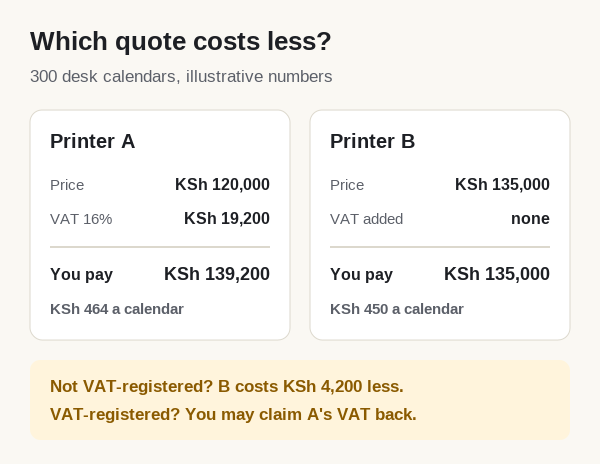
A worked example (illustrative numbers, not a market price): Printer A quotes KSh 120,000 for 300 desk calendars, plus 16% VAT. VAT is KSh 19,200, so you pay KSh 139,200, or KSh 464 a calendar.
Printer B is not registered for VAT and quotes KSh 135,000 for the same 300 calendars. You pay KSh 135,000, or KSh 450 a calendar. If your business is not registered for VAT, B costs KSh 4,200 less.
If your business is registered for VAT, you may be able to claim A's KSh 19,200 back as input tax[4], so A can cost less. Ask your accountant which applies to you.
For timing, ask each printer for their dates in writing: when they need final artwork, when you get the proof, when the sample is ready, and the delivery date. Then add a few days of your own for checking and for changes.
The longest jobs are usually the ones with special finishing, imported blank gifts, or many personalised names. If you need any of those, send your brief first.
What about gift bags and packaging?
If your gifts go out in branded carrier bags, make sure they are not plastic carrier bags. NEMA, the National Environment Management Authority, says it is illegal to use, import or manufacture plastic carrier bags in Kenya[5].
NEMA has also directed suppliers and users to stop using non-woven polypropylene bags (the cloth-like ones) from 31 March 2019 until KEBS gazettes a quality standard for them[5].
Before you order any, ask the supplier to show that the bags meet a current KEBS standard, or choose paper, cloth or boxes.
Ask for a sample bag too, filled with the actual gift, to check that the handles hold the weight.
How should you pay a printer, and what protects you?
Pay in stages: a deposit to confirm the order, and the balance after you have checked the delivery against the sample. Avoid paying the full amount upfront to a printer you have never used.
Pay to a business till or paybill in the printer's business name, not a personal number. Keep every M-Pesa message in one chat or folder.
Before a big deposit, check the printer's KRA PIN on the PIN Checker, which KRA says verifies whether a PIN is genuine or not[7].
Ask for an eTIMS invoice, the electronic tax invoice registered with the Kenya Revenue Authority (KRA). KRA says compliant invoices carry a QR code you can scan, and you can also use its invoice checker[6][7].
If a dispute cannot be settled, the Small Claims Court handles civil and commercial disputes worth up to KSh 1 million, in a simple and cost-efficient way[8]. Your brief, approved proof, sample and M-Pesa messages are your evidence.
What habits make end-year printing easier?
A few habits make the whole job easier.
Small things that save money and stress:
- Collect staff and client names in one typed list, checked by each department, before you send it to the printer
- Order a few extra pieces for late additions and damage in transport
- Ask the printer to pack and label boxes by branch or recipient if items go to several places
- For deliveries upcountry, agree who pays the courier and who carries the risk until the boxes arrive
- Keep this year's approved files and a note of what worked, ready for next year
What should you never do when ordering branded printing?
Most losses come from a handful of habits. Avoid them every time.
Do not:
- Approve a proof on a call, or from a small phone preview alone
- Let the full run start before you have seen a finished sample
- Pay the full amount upfront to a new printer
- Pay to a personal number when the printer says they are a business
- Print logos, photos or fonts you do not have the right to use
- Order plastic carrier bags for gifts[5]
- Leave the delivery date as "before the holidays" instead of a real date
What mistakes do buyers make with branded printing?
Comparing headline prices. One quote includes VAT, design and delivery, another does not. Instead, compare the total you will pay, per piece, with VAT[4].
Approving the proof alone. Instead, read it line by line with a second person, call the phone numbers, and reply "Approved" in writing.
Using last year's calendar template. Holiday names and dates change. Instead, check every holiday against the Public Holidays Act and the Sunday rule for the new year[2].
No sample. Instead, approve one finished piece and write "bulk to match approved sample" on the order[3].
Forgetting the files. Instead, agree in writing that the design is yours and get the source files on final payment[1].
Leaving it to December. Instead, send the brief as early as you can and ask for every date in writing.